



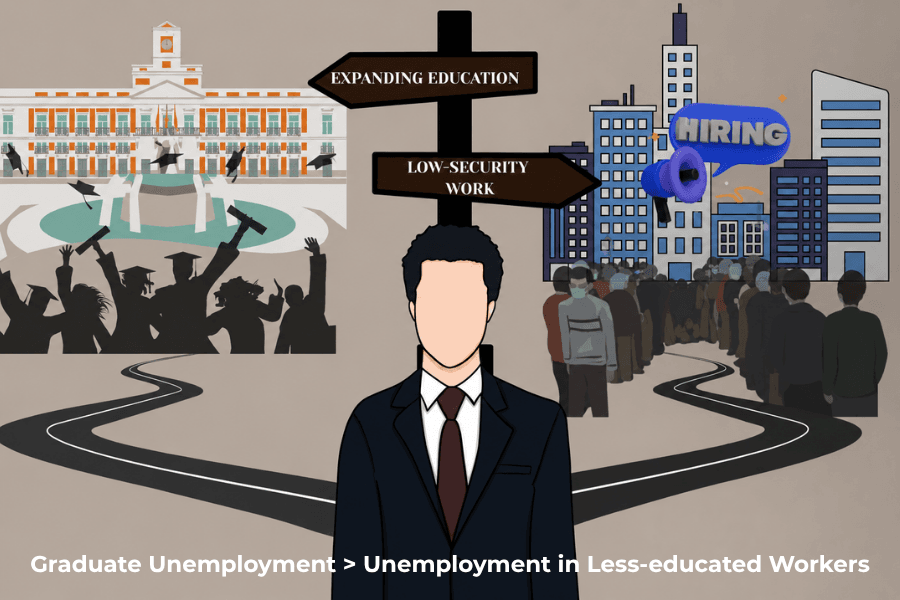
Over the past two decades, India’s higher education system expanded rapidly. Universities grew across states, enrolment increased sharply, and the country began producing one of the world’s largest graduate cohorts. For many first-generation learners and lower-income households, higher education increasingly represented the promise of economic mobility and entry into the middle class.
Yet the economy has not generated enough high-value employment to absorb this expanding pool of educated workers. Graduate unemployment remains higher than unemployment among less educated workers in several parts of the country, while many employed graduates continue to work in low-security occupations and informal enterprises.
This mismatch marks a deeper shift in India’s development trajectory. Degrees still improve employment prospects, but they no longer guarantee entry into durable middle-class careers. For many young workers, higher education now functions as a gateway into a crowded and uncertain job market rather than a reliable route to economic security.
Expanding access to higher education is no longer enough. The challenge lies in whether regional economies can generate sufficient opportunities for educated workers entering the labour force each year.
Uneven Geography of Graduate Opportunity
India’s higher education expansion unfolded nationally, but the economic opportunities available to graduates remain deeply uneven across states. The value of a degree now varies sharply depending on where workers enter the economy.
Evidence from the State Graduate Labour Market Outcomes Index (GLMOI), constructed using the Periodic Labour Force Survey (PLFS) 2023–24, reveals widening regional differences in graduate outcomes. States with stronger urbanisation, diversified economic activity, and larger formal sectors are better positioned to support professional employment for educated workers, even through different development pathways. Sikkim has prioritised employment access, Puducherry occupational alignment, and Mizoram job quality as distinct approaches to economic transition.
At the other end, Bihar and Uttar Pradesh continue to face major constraints in graduate earnings, occupational mobility, and skill utilisation. Slower industrial growth, weaker urban development, and a thinner formal employment base continue to restrict opportunities for educated workers.
These differences are altering the meaning of educational opportunity across India. Local economic conditions play a far larger role in determining whether education translates into income mobility and career stability.
Underemployment and the Declining Wage Premium
One of the clearest signs of this transition is the growing scale of educated underemployment. Large sections of India’s graduate workforce are now employed in occupations historically associated with much lower educational qualifications. Many graduates compete for jobs once linked primarily to secondary-level education.
This pressure reflects the limited capacity of the economy to generate enough professional and high-skill employment relative to the size of the educated workforce. Sectors such as technology and finance continue to expand, but they absorb only a small share of graduates entering the labour market each year. Uneven manufacturing growth has further narrowed pathways into formal salaried roles across several regions.
The consequences extend beyond occupational mismatch alone. As more graduates compete for a limited number of long-term positions, wage premiums associated with degrees begin to weaken. Educational attainment still improves employment prospects, but the economic returns to degrees are becoming less predictable than they were during earlier phases of economic transformation.
For many households, degrees remain necessary for upward mobility, but no longer sufficient to secure it.
Informality Still Defines Graduate Work
Informality continues to shape employment conditions for a large share of India’s educated workforce. More than half of employed graduates remain concentrated in enterprises that operate without predictable earnings, written contracts, or meaningful social-security protections.
For many graduates, informal work no longer represents a temporary phase before entering formal employment. It increasingly defines long-term career trajectories. Even workers with higher educational qualifications often move into low-security occupations because large sections of the economy continue to generate limited formal employment.
The implications extend well beyond workplace conditions. Weak earnings and insecure employment influence household consumption, migration decisions, savings behaviour, and long-term social mobility. They also affect how families perceive the economic value of higher education itself.
Educational attainment can improve individual opportunities, but it cannot fully offset broader weaknesses in employment generation. Without stronger enterprise growth, rising productivity, and wider access to formal salaried roles, higher education alone cannot consistently deliver middle-class economic stability.
Cities and the New Geography of Opportunity
Regional disparities in economic opportunity are reshaping migration patterns across India. Southern and western states have generally benefited from stronger urbanisation, industrial diversification, and service-sector expansion, while several northern states continue to face slower structural transformation and weaker employment growth.
Cities now occupy a central position in this transition. Educated workers tend to gravitate toward urban centres that offer stronger infrastructure, larger professional networks, deeper consumer markets, and greater concentrations of formal-sector activity. Urban economies increasingly concentrate the institutions and enterprises that connect education to long-term employment mobility.
These patterns are likely to intensify as educational attainment rises further. States capable of building dynamic urban economies are expected to attract a larger share of mobile skilled workers, reinforcing existing regional differences in opportunity and income growth.
Migration therefore reflects more than wage differences alone. It increasingly mirrors the uneven ability of regional economies to create durable career pathways for educated workers.
India’s Next Employment Transition
India has already demonstrated that large-scale higher education expansion is institutionally achievable. The next challenge is ensuring that educational gains translate into durable employment and upward mobility across regions.
This requires policy attention to move beyond enrollment growth alone. Indicators such as earnings progression, employment quality, occupational alignment, and access to social security can provide a clearer picture of whether higher education is producing long-term economic mobility for graduates.
The challenge ahead is fundamentally structural. Expanding the number of graduates without strengthening the sectors that employ them risks deepening underemployment, wage pressures, and regional inequality. Industrial diversification, enterprise growth, and stronger urban economies will increasingly determine the quality of graduate outcomes across states.
India’s demographic dividend will ultimately depend less on how many degrees the country produces and more on whether educated workers can build stable careers within the regions where they study, rather than being pushed into cycles of migration, underemployment, and insecure work. States that succeed in creating broad-based opportunities for skilled workers are likely to define the next phase of India’s economic trajectory.