



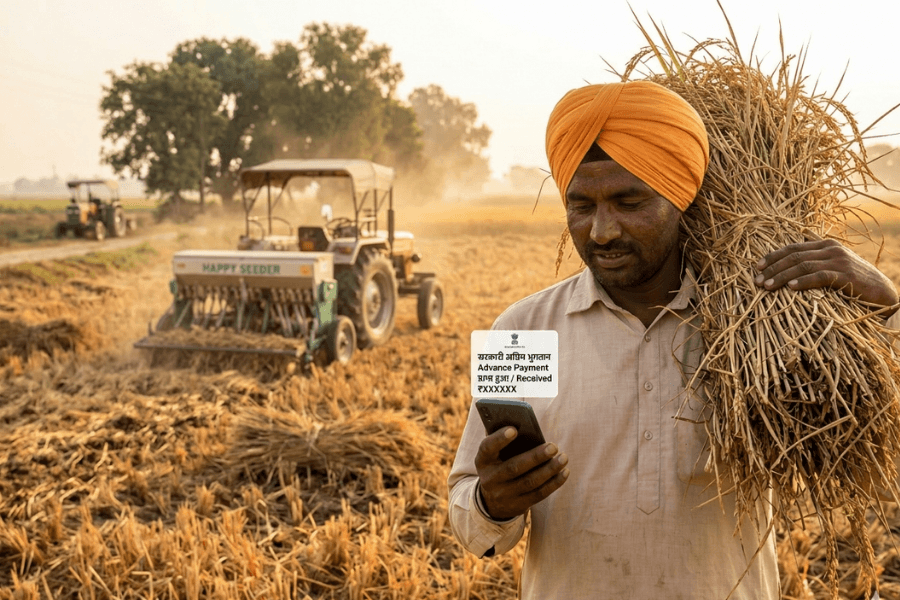
Every winter, a grey haze settles over North India. Air pollution in the region cuts life expectancy by an estimated six to nine years, and seasonal agricultural fires account for a substantial share of this burden. Crop residue burning alone contributes significantly to Delhi’s winter pollution, much of it originating in Punjab, where close to four million acres of paddy are set alight in a single season. The consequences extend far beyond the region, with tens of thousands of premature deaths nationwide and economic damages running into billions of dollars each year.
The health costs are well documented yet burning persists at scale. This is because for millions of small and medium farmers, it is the quickest and most cost-effective alternative to clear their fields before replanting in the winter. Avoiding crop residue burning requires action within a narrow window between rice harvest and wheat sowing. Alternatives are technically available, but they often involve immediate costs. Managing residue in-situ can cost about ₹3,000 per acre, while removing residue using a baler typically costs around ₹1,000 per acre. For a farmer cultivating five acres, this translates into an additional outlay of ₹5,000 to ₹15,000 within days. These private decisions aggregate up to large social costs, implying that policy to reduce burning has large social benefits.
Policy Landscape
Policy has not been silent on this issue, and government policies have included bans as well as subsidies for crop residue management technologies intended to enable sowing without burning. Taken together, the policy response appears comprehensive: a legal ban reinforced by technical alternatives.
In practice however, this combination has proved insufficient. Enforcement is costly to implement with limited state capacity and carries political costs. The environmental harm from burning spreads across districts and state borders, while the costs of deterrence are borne locally, weakening incentives to enforce. Subsidies, meanwhile, lower equipment costs but do not address the operational and timing constraints that shape decisions in the sowing window.
The Promise of Payment for Ecosystem Services and Importance of Contract Design
Payments for ecosystem services (PES) offer a mechanism to align farmers’ incentives to reduce burning, by explicitly tying payments to outcomes (no burning), However, institutional frictions may impede the efficacy of such contracts in two important ways. First, these costs arise at a time when liquidity may be tight. Baseline surveys across 171 villages in Punjab indicate that fewer than half of farmers had ₹5,000 in readily available savings at the time of harvest, and access to short-term credit was limited. Second, incurring costs upfront in exchange for a payment promised later can be risky. Participation in outcome-based contracts may therefore depend not only on farmers’ resources, but also on whether they trust that promised payments will be delivered. Such frictions (liquidity and trust) imply that contracts which explicitly target these frictions may be more effective than commonly used PES contracts, which only pay the full amount post verification.
We randomized the offer of PES contracts to farmers in 120 villages that target the above institutional frictions as well as standard PES contracts (farmers within a village were offered the same type of contract). Under a standard design, farmers in 58 villages were offered payments of either ₹800 or ₹1,600 per acre, disbursed only after verification that their fields had not been burned. Under an alternative design, farmers in 62 villages received an advance equal to 25 or 50 percent of the total payment (₹ 800 per acre), with the remainder paid after verification. Farmers in another randomly chosen 51 villages continued under the status quo and received no contracts.
Participation was voluntary. Compliance was verified through remote sensing measures developed from a combination of on-ground inspections and high-resolution satellite imagery capable of detecting burn patterns at the plot level. Farmers faced no penalties beyond forfeiting the conditional payment if burning was detected.
Timing Changes Behaviour
The two contract designs differed only in the timing of payment, not in the total amount offered. This distinction proved consequential. Under the standard design, post-verification payments did not translate into meaningful reductions in burning. Only 8.5 percent of enrolled farmers complied with the contract, and satellite-based monitoring detected no significant decline in fire activity relative to villages without contracts.
Outcomes differed under the alternative design that included an advance payment. In these villages, compliance rose to 18 percent, and satellite measures indicate that burning declined by between 7.7 and 11.5 percentage points compared to villages without contracts. Payment timing affected behaviour at the margin within the same agricultural season. Furthermore, the standard contracts which offered a total payment of ₹ 800 per acre were more effective in reducing burning than offering farmers ₹1600 per acre under a standard contract.
How Farmers Responded
The behavioural response to the advance-payment contract was visible in how farmers managed residue during the sowing window. Use of balers – an option that allows residue to be removed quickly and with fewer operational steps – increased by roughly 10 percentage points in villages receiving upfront payments. There was no corresponding increase in the use of subsidised in-situ management technologies such as the Happy Seeder.
Welfare Arithmetic: Why It Pays
Even modest reductions in residue burning generate large public benefits. Under the advance-payment design, the fiscal cost amounted to approximately ₹2,700 to ₹4,050 per acre that remained unburned.
By contrast, conservative estimates place the mortality damage associated with residue burning at roughly ₹5 lakh per acre. Measured against this benchmark, the public expenditure required to induce compliance is small relative to the health damages avoided. The implied cost per life saved – approximately ₹3 lakh to ₹4.5 lakh – falls well below commonly used thresholds for evaluating public health and environmental interventions. Thus, PES contracts targeting institutional frictions offer a promising alternative to reduce burning, which has large societal costs.
Scaling
Scaling an outcome-based incentive programme introduces new challenges, which must be addressed during the scaling process. A successful incentive programme would raise demand for residue-management services. If supply does not expand alongside demand, rental prices could rise, eroding the operational advantages that enabled farmers to respond to the incentive. Preserving effectiveness at scale therefore requires attention not only to incentives, but also to the equipment and service markets through which farmers manage residue. However, scaling also offers benefits, such as the need for upfront payments possibly reducing over time as farmers’ trust in timely payments increases, and monitoring costs reducing as monitoring technologies improve. The enormity of the social costs of burning justifies an investment in PES and other programmes to reduce residue burning– and in understanding how to make them work for farmers.