



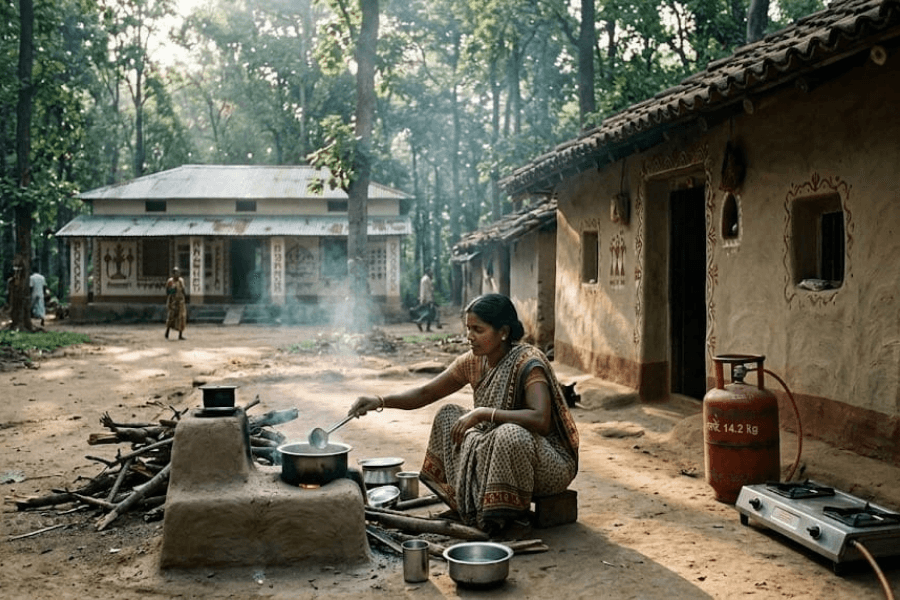
Under the Pradhan Mantri Ujjwala Yojana (PMUY), more than 80 million liquefied petroleum gas (LPG) connections were extended to households by 2020, dramatically widening access to modern cooking fuel. Yet in Scheduled Areas – constitutionally protected regions covering about 11.3 percent of India’s land and home to a large share of the country’s Scheduled Tribe (ST) population – clean fuel use remains persistently lower.
This shortfall is not marginal. Analysis of Mission Antyodaya Survey data, sourced from SHRUG, shows that villages located just inside Scheduled Area boundaries record a 3-4 percentage point lower use of clean cooking fuels compared to villages just outside. The gap persists across distances of 5 to 20 kilometres from the boundary, indicating that poverty alone cannot explain it. Where ST populations exceed 10 percent of village residents, the decline in LPG and PMUY use is sharper still. The pattern points to a deeper issue: India’s clean cooking challenge is no longer about access alone; it is about sustained use and about why usage stagnates precisely in regions where constitutional protections, local autonomy, and ecological stewardship are strongest.
Uniform Energy Policy, Differentiated Governance
Scheduled Areas are governed differently by constitutional design. Their origins lie in colonial “Scheduled Districts,” created under the 1874 Act to administer regions with distinct social and political institutions. After Independence, the Fifth Schedule of the Constitution preserved this differentiated approach, granting special protections over land, resources, and governance to safeguard tribal autonomy while enabling targeted development.
The Panchayats (Extension to Scheduled Areas) Act, or PESA, enacted in 1996 further deepened this framework. The Act extended local self-government to Scheduled Areas with 50 percent seats reserved for STs across all layers of local governance. Gram Sabhas – the village assembly – were granted authority over beneficiary selection, land alienation, and the management of minor forest produce. These provisions were intended to correct historical dispossession and strengthen community control.
Political Representation Delivers, Selectively
Lower LPG usage in Scheduled Areas is not evidence of weak or ineffective political representation; outcomes across other public goods suggest the opposite. Constituencies reserved for ST legislators show improved delivery of rural housing under the Pradhan Mantri Awas Yojana (PMAY) and better road connectivity under the Pradhan Mantri Gram Sadak Yojana (PMGSY). These gains are especially pronounced in villages with higher ST population shares, indicating that tribal representatives are effective in advancing development priorities that align with local needs.
This contrast matters. It shows clean cooking stands apart as a scheme with distinct frictions. PMAY and PMGSY involve one-time asset provision – houses and roads – while LPG depends on repeated market transactions in the form of cylinder refills. The distinction is not semantic: it shapes how local incentives, administrative discretion, and household choices interact.
One important local incentive that potentially interacts with clean fuel use is the ease of accessing forest products. The Forest Rights Act of 2006 gives Gram Sabhas legally enforceable authority over forest resources. In practice, this creates an asymmetry: access to biomass is protected by statute, while clean fuel use depends on affordability, supply chains, and repeated engagement with markets.
Forests as a Competing Energy Source
Scheduled Areas are not only politically distinct; they are ecologically distinct. ST populations are concentrated in forested landscapes, where average tree canopy cover is around 12 percent, compared to about 9 percent elsewhere. These regions have also experienced higher forest cover growth over the past decade.
This ecological context directly shapes energy choices. Forest cover displaces clean fuel use in both Scheduled and non-Scheduled Areas, but the effect is substantially stronger in the former – roughly twice as large. In Scheduled Areas, PMUY uptake falls by about 10 percent as canopy cover increases. These effects remain robust even after accounting for elevation, terrain ruggedness, night-time light intensity as a proxy for economic activity, and the presence of pucca roads.
Evidence from the India Residential Energy Survey 2020 reinforces this pattern. In Scheduled Areas, firewood dominates as the primary cooking fuel, with ST households trailing others by nearly 20 percentage points in LPG use. Where biomass is locally available, culturally embedded, and legally protected, subsidised LPG must compete not only on price, but on convenience and institutional fit.
Empowerment, Conservation, and a Clear Trade-off
The rollout of PESA sharpens this dynamic by operating at what might be called the intensive margin of political empowerment – how governance functions within Scheduled Areas rather than whether representation exists at all. On average, PESA implementation is associated with a modest increase in PMUY coverage across Scheduled Areas. But this average masks sharp ecological variation.
In villages located in open forests and scrublands, PESA increases PMUY uptake. In contrast, in areas characterised by moderately dense forests, PESA adoption is associated with a large and statistically significant decline in PMUY use. It indicates that political empowerment of the STs can increase firewood availability in areas that already has dense forest cover.
The mechanism becomes clearer when forest outcomes are examined directly. Following PESA implementation, forest cover increases by about 0.4 percentage points on average, with larger gains at the upper end of the forest distribution. This suggests that empowered local institutions strengthen forest stewardship. But the same conservation gains increase access to biomass, reinforcing reliance on traditional fuels.
What emerges is a three-way trade-off. Political empowerment improves access to public assets and strengthens local governance. Ecological stewardship delivers measurable conservation gains. But clean cooking – dependent on repeated use rather than one-time provision – loses ground in forest-rich settings.
Designing Clean Energy for Constitutionally Distinct Regions
These outcomes do not suggest that tribal self-governance has failed, nor that conservation successes should be rolled back. Instead, they reveal the limits of uniform clean energy policy on constitutionally differentiated land. On roughly one-ninth of India’s territory, clean cooking goals intersect with legally protected forest rights and empowered local institutions.
The policy challenge is therefore alignment, not override. Clean fuel delivery must work with forest governance rather than around it. Reducing transaction costs for refills, integrating LPG distribution with forest-based institutions, or aligning energy delivery with locally trusted cooperatives are not departures from decentralisation; they are adaptations to it.
India’s clean cooking transition has succeeded in expanding connections at scale. The harder task now is sustaining use in contexts where political empowerment and ecological abundance reshape incentives. The lesson extends beyond LPG: when welfare shifts from one-time assets to repeated-use services, constitutional diversity and local ecology matter as much as fiscal scale.