



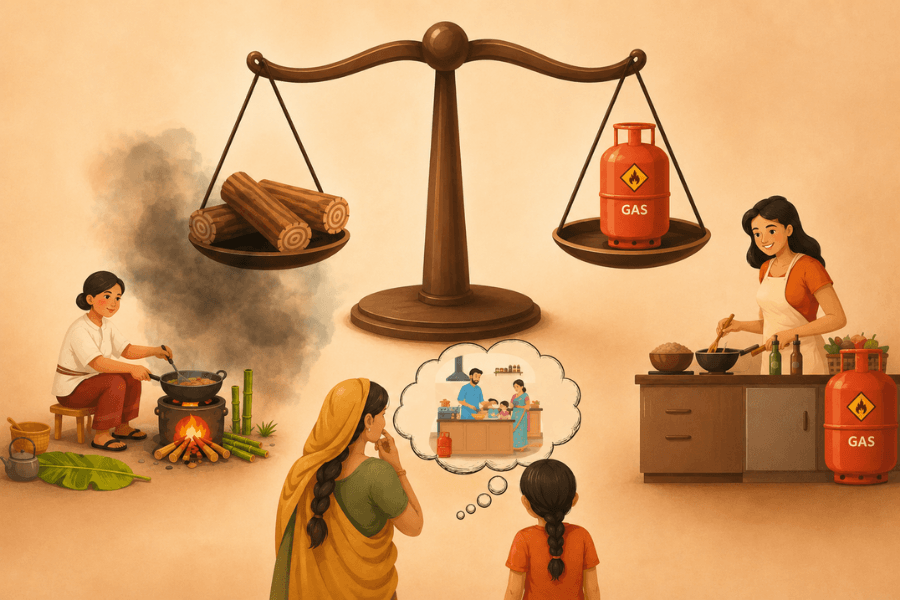
India has dramatically expanded access to Liquefied Petroleum Gas (LPG), making cleaner cooking a realistic option for millions of rural households. Yet many families continue to rely on firewood despite possessing LPG connections, while others routinely combine traditional and modern fuels. Evidence from three decades of data covering nearly 1.2 crore rural households across 314 villages in Bihar suggests that access alone does not explain these different trajectories. India’s clean cooking mission has entered a new phase where sustaining everyday adoption is now the principal challenge.
Clean cooking delivers benefits far beyond household energy, including better health, lower indoor air pollution, reduced drudgery for women and less pressure on forests. India’s clean cooking mission has therefore reached a different stage. Expanding access remains important, but ensuring sustained adoption has become the more pressing policy challenge.
Why Cleaner Cooking Transitions Stall
Much of household energy policy has been guided by the Energy Ladder hypothesis, which assumes that rising incomes and better access to cleaner fuels encourage households to move progressively from traditional biomass to modern alternatives such as LPG and, eventually, electricity. The framework has shaped policy for decades because it captures an important reality: economic progress usually expands households’ energy choices.
The transition, however, is rarely as linear as the theory suggests. Rather than replacing one fuel with another, many rural households continue to use several fuels simultaneously. LPG may be preferred for preparing quick meals, while firewood remains the fuel of choice for traditional dishes, cooking for large families or when refill costs become difficult to manage. The transition is therefore additive rather than sequential, meaning that an LPG connection creates the opportunity to cook cleanly but does not ensure that cleaner cooking becomes the household norm.
This persistence of fuel stacking reflects influences that extend well beyond household income. Reliable refill services, responsive distributors, functioning local markets and community organisations all influence whether LPG becomes a dependable everyday fuel or remains one option among many. Cooking practices are also shaped by routines, food preferences and social norms, making clean cooking a behavioural transition as much as an economic one.
The Bihar evidence illustrates these dynamics at scale. Communities with broadly similar economic conditions often follow very different transition pathways. Some move steadily towards sustained LPG use, while others remain heavily dependent on traditional fuels despite improved access. The difference often lies in the institutional and behavioural environments within which households make everyday cooking decisions.
Why Uneven Transitions Matter
The findings also challenge the assumption that progress can be judged through average improvements alone. When communities adopt cleaner cooking at different rates, headline gains in LPG coverage can mask persistent disparities in everyday fuel use.
One way to understand this unevenness is through energy inequality, which measures how evenly cleaner cooking is distributed across households. Bihar records a firewood energy inequality score of 0.45 on a scale of zero to one, compared with 0.37 in Odisha and 0.33 in Maharashtra. It also records a lower multidimensional development score of 0.38 than Maharashtra’s 0.56. These patterns suggest that places where clean cooking transitions remain more uneven also tend to lag on broader measures of development.
The implication extends beyond clean cooking. As public programmes mature, expanding access becomes only one dimension of success. Measuring sustained adoption alongside coverage would provide a more realistic picture of whether households are genuinely moving towards cleaner energy use.
From Expanding Access to Sustaining Adoption
The first phase of India’s clean cooking mission focused on expanding access by extending LPG connections, reducing financial barriers and strengthening distribution systems. Those investments have fundamentally changed the country’s household energy landscape. In doing so, they have also changed the policy challenge.
The next phase still requires national programmes to maintain scale, but policy must increasingly address the local conditions that determine sustained adoption. Progress also needs to be measured differently. Tracking sustained LPG use alongside disparities in adoption would provide policymakers with a clearer picture of where the transition is succeeding – and where additional support is still required.