



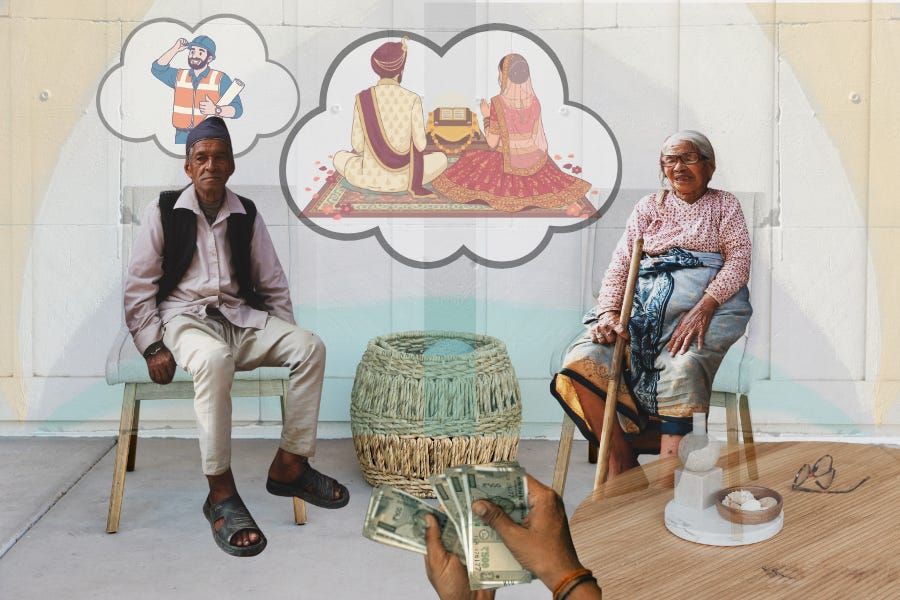
Historically, dowry was seen as a bequest to the bride – a way for daughters to receive inheritance at marriage in patrilocal societies. Over time, property rights over these transfers shifted: in many regions today, grooms’ parents control a substantial share of what is given at marriage. This modern configuration is the starting point for understanding dowry’s contemporary economic effects, while many discuss it in legal or moral terms.
Dowry performs an additional function that has received far less attention: it acts as a liquid, marriage-timed transfer that influences whether sons migrate and how households manage old-age support. This economic role has become increasingly relevant in the current setting with persistent rural–urban wage gaps and limited formal pension coverage.
The Intergenerational Bargain Behind Migration Decisions
A simple intergenerational mechanism explains why dowry matters for migration. Parents often rely on sons for old-age support, especially where married sons live nearby. Migration disrupts this arrangement. When a son moves to a city or industrial corridor, his earning potential rises, but the ease with which parents can draw on his income declines. For households without independent means, this creates a real constraint: even when migration offers high returns, parents may hesitate to support it if it reduces their consumption.
A useful distinction is between “Satisfied” parents, who can maintain their preferred living standard on their own income and assets, and “Seeking” parents, who depend on regular income-sharing with their son. For the latter group, the migration decision is tied to whether they can be compensated for the loss of easy access to his earnings.
Why Marriage-Linked Liquidity Matters
Dowry becomes relevant because it arrives at exactly the moment when marriage and migration decisions are made. A liquid transfer can be split between the couple and parents, creating a cushion that partly substitutes for co-residence-based support.
In effect, dowry can relax the financial constraint that Seeking parents face. It lowers the minimum return a migration opportunity must promise for the household to support the son’s move.
Empirical patterns support this mechanism. In a rural survey covering districts across six northern and central states – areas where parents reside and sons typically migrate from – 27–29 percent of parents report ending up as net financial beneficiaries of the marriage transfer. In a complementary survey of married men working in an urban hub near Delhi – a major destination for labour migrants – the corresponding share is around 45 percent. Dowry giving is nearly universal, but the portion retained by parents varies sharply. Crucially, this variation aligns with mobility: compared with parents of non-migrant sons, parents of migrant sons are 8 percentage points more likely to be net takers in the rural sample, and about 27 points more likely in the Delhi sample.
Transfer Channels: Family Authority, Income, and Remittances
The internal allocation of dowry depends on bargaining power and income structures. Where sons report that they would not have married without parental approval – a proxy for parental veto authority – parents are around 25–30 percentage points more likely to retain part of the marriage transfer. Similarly, among migrant sons, parents take more when the son works in higher-earning occupations: a doubling of the son’s occupational earnings score is associated with roughly a 19-percentage-point increase in the likelihood that parents keep a share. These patterns indicate that households use marriage-time transfers to rebalance consumption across generations when migration alters how income can be shared.
Remittances might seem like an alternative to dowry for supporting parents, but the evidence suggests they are used together rather than in place of each other. Because sending money home can be costly or uncertain, families tend to rely on dowry as the initial reliable transfer and use remittances to top up later. Among migrant sons, parents who receive remittances are 17 percentage points more likely to have retained part of the dowry than those who do not. In effect, households combine the two: a large, one-time transfer at marriage followed by periodic earnings from the city.
Dowry Traditions and District-Level Migration Patterns
At the district level, historical dowry prevalence strongly predicts male migration today. This measure – derived from ethnographic records of groups that traditionally practised dowry – continues to explain variation in the size and liquidity of modern marriage transfers, even though dowry itself is now widespread. Districts with deeper dowry norms show higher migration because these traditions make marriage-time transfers more liquid and therefore better able to finance moves to distant, higher-return labour markets.
Interaction with Infrastructure Investments
The link between dowry and migration also appears when looking at how districts respond to new infrastructure. When major highway corridors – the Golden Quadrilateral and the North–South/East–West networks – reduced travel times, districts with stronger dowry traditions experienced sharp rises in young men’s migration, with increases of around 4–6 percentage points in the years after the roads were completed. In districts where dowry norms were weaker, the migration response was close to zero, even though connectivity improved in the same way.
Most of this increase came from young men moving out of their home districts for work – moves that reduce day-to-day income sharing with parents. Older men, who had typically married before the highways arrived, show little to no change. The timing fits the mechanism: dowry provides liquidity at marriage, so its influence on mobility is strongest when marriage and new migration opportunities occur close together.
Households with Sons and Daughters
Accounting for households with both sons and daughters does not change the mechanism. When a family pays dowry for a daughter but may receive a transfer from a son’s marriage, these two flows could potentially offset each other. Even then, the theoretical results show that a liquid transfer at marriage still reduces the gap between parents’ and sons’ consumption if the son migrates.
Across different household compositions, the effect varies in predictable ways: households where sons outnumber daughters show a positive migration effect; those with more daughters show a negative effect; equal numbers show none; and households with no sons are unaffected. Given that many households fall into the first category – having one or more sons – the theoretical results again show that the aggregate impact of dowry on male migration stays positive.
Aligning Social Protection with Household Economics
Dowry continues to play this economic role because formal pensions, low-cost risk-sharing, and reliable remittance systems remain limited. Where migration separates generations, households use the instruments available to them to manage intergenerational support.
Possible policy responses could seek to replace this economic function, not only restrict the practice. This potentially involves expanding dependable pensions; lowering remittance costs and making welfare benefits such as food rations and health services portable across states; improving safe and affordable housing for young migrants to make income-sharing with parents easier; and strengthening women’s property rights, which shape who ultimately controls marriage-linked assets.
In a more modern and mobile labour market, it is modern social insurance – not marriage – that must carry India’s intergenerational burdens.