



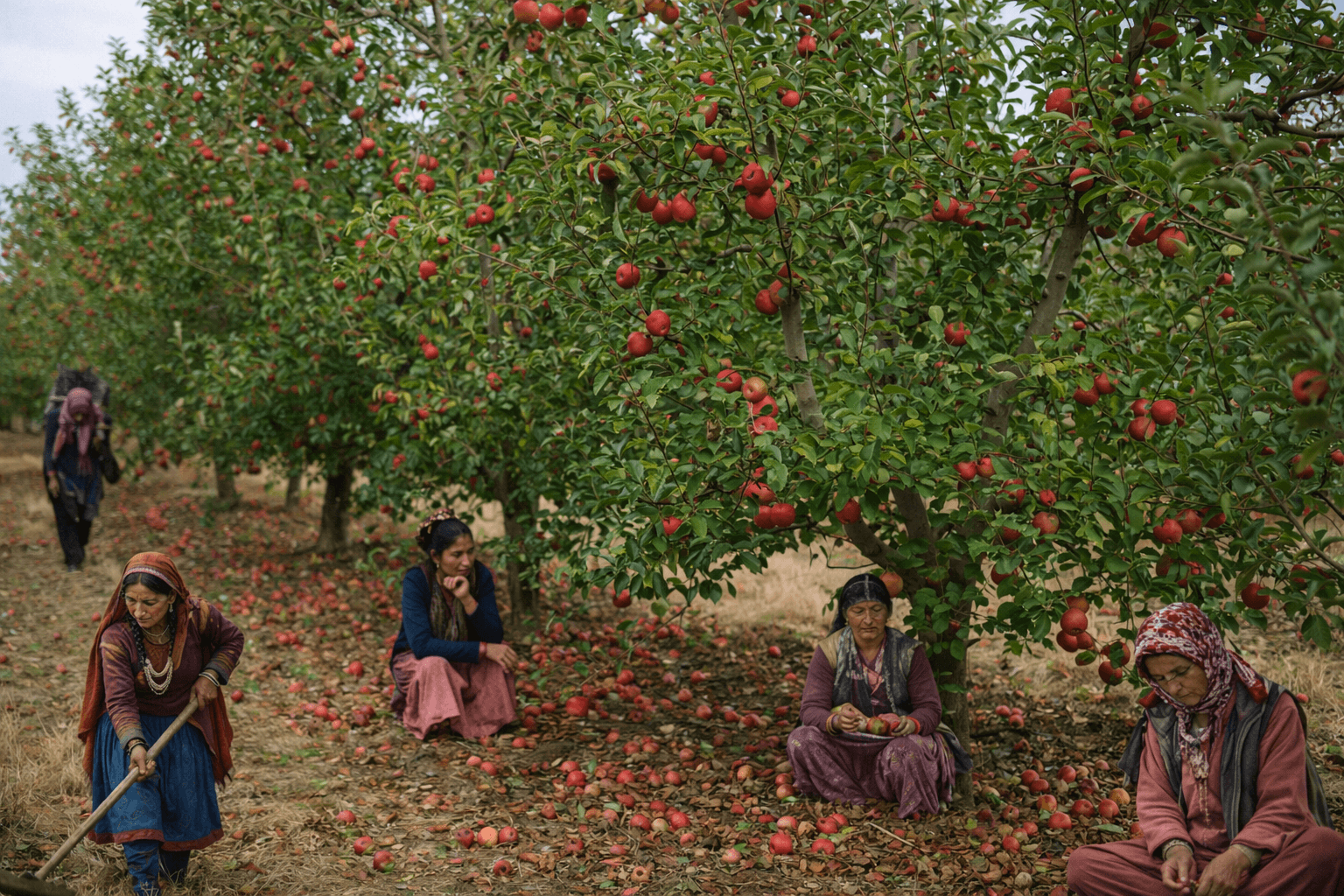
Kashmir’s agricultural and horticultural economy – often cited as a pillar of rural income and resilience – rests on a labour arrangement that policy seldom acknowledges formally. A critical share of the work that keeps farms productive and orchards viable, especially during peak agricultural and post-harvest phases, is performed by women within the household – whose work never enters wage accounts, productivity estimates, or labour statistics.
In agrarian regions like rural Kashmir, this mismeasurement does more than distort gender statistics – it leads agricultural planners and labour analysts to underestimate the true labour intensity, cost structure, and vulnerability of farm-based production systems.
The Measurement Blind Spot – and Why It Matters
Recent labour force surveys show that many working women in Jammu and Kashmir are engaged in agriculture, largely as farm labourers. Yet these figures capture only activities performed against a wage. Labour contributed on family farms, kitchen gardens, orchards, and in post-harvest processing – where remuneration is absent or informal – falls outside the statistical boundary of “work”.
This exclusion allows agricultural output to appear less labour-intensive and more productive than it actually is. Women routinely spend long hours transplanting paddy, pruning apple trees, grading and sorting produce, or preparing goods for sale. Because payment does not change hands, this labour is treated as a household input, while its returns accrue to farm income and regional output.
The result is a persistent misreading of economic reality. Labour force participation rates signal disengagement where none exists, and policy debates begin from a flawed premise that women need to be brought into economic activity, rather than that existing economic activity needs to be recognised, valued, and reorganised.
Agrarian Structure and the Economic Logic of Unpaid Labour
Kashmir’s agrarian economy is shaped by small and increasingly fragmented landholdings. With average operational holdings well below the national average, households operate under tight margins and limited capacity to absorb hired labour costs, particularly during peak seasons. In this context, unpaid family labour becomes a rational economic adjustment rather than a residual social practice.
This logic has intensified with the region’s shift towards horticulture. Apple cultivation and allied activities require repeated, labour-intensive interventions across the year – pruning, harvesting, grading, packaging, and storage. Much of this work is absorbed within the household, and women form the backbone of this labour supply. Their contribution is directly linked to market-facing output and value chains, not merely to household subsistence.
This reliance is economic first and gendered second. Structural constraints push farms to minimise cash outflows; prevailing norms determine whose labour absorbs the adjustment.
A Necessary Counterfactual: What If This Labour Were Paid?
If women’s labour in these activities had to be remunerated at prevailing agricultural wage rates, farm costs would rise sharply during peak seasons. For many smallholders, this would compress margins sufficiently to force changes in cultivation intensity, technology use, or scale.
The continued reliance on unpaid labour thus masks the true cost of production. What appears as resilience is, in part, the deferral of adjustments that would otherwise be triggered by explicit labour costs – financed through women’s unpaid time.
How Women’s Time Absorbs Economic Risk
Within rural households, this adjustment manifests as a highly unequal allocation of time. Women combine unpaid farm labour with domestic work, childcare, livestock care, and kitchen gardening, resulting in long workdays with little discretionary time. Men’s agricultural work, though often physically demanding, is more clearly bounded and followed by greater control over leisure and income.
This asymmetry matters because time poverty constrains transition. Even where opportunities exist in paid agricultural or allied activities, women’s capacity to take them up is limited by existing unpaid workloads. The binding constraint is not participation but the impossibility of exiting unpaid labour.
Control over income mirrors this structure. Proceeds from crop sales are typically managed by male household heads, allowing farm incomes to be pooled without altering control arrangements. Production costs remain low, but women’s dependence deepens. Household stability is achieved by transferring economic volatility onto women’s time.
When Resilience Becomes an Economic Constraint
These arrangements are often justified as necessary for survival. Kashmir’s exposure to climatic shocks, political disruptions, and natural disasters has fostered a strong ethic of collective resilience. While often celebrated as social strength, this form of resilience operates as a private coping mechanism for public risk.
In the long run, it imposes costs on women by limiting skill accumulation, income autonomy, and exposure to the wage economy. When circumstances later compel women to seek paid work – due to widowhood, illness, or income shocks – they are frequently pushed into low-paying, informal roles with little security. What stabilises households in the short run thus generates individual precarity and entrenched disadvantage over time.
Recognition as Economic Redesign, Not Symbolic Inclusion
Together, these dynamics distort labour diagnostics and overstate productivity, encouraging policies that add women to the workforce rather than restructuring the work already being done.
Addressing this problem does not require dismantling household production systems or celebrating unpaid labour as resilience. It requires redesign. Recognition matters because it determines whether skilling, credit, and market-access policies are designed around women’s existing workloads or simply layered on top of them.
Better measurement – through integrating time-use data into labour and agricultural surveys – is a necessary starting point, but not a sufficient response. Recognition must enable restructuring: creating pathways for women to move into remunerated roles within agri-value chains, strengthening women’s control over farm income, and designing rural employment interventions that rebalance production costs rather than deepen time poverty.
From Hidden Subsidy to Policy Recognition
Rural Kashmiri women are not outside the economy; they are embedded at its core. As long as rural production systems rely on unpaid female labour to remain viable, policy will face a trade-off between apparent efficiency and long-term sustainability.
The question, then, is not whether women in rural Kashmir work – but whether India’s development framework is prepared to confront the economic dependence it has built on work that remains unpaid.