


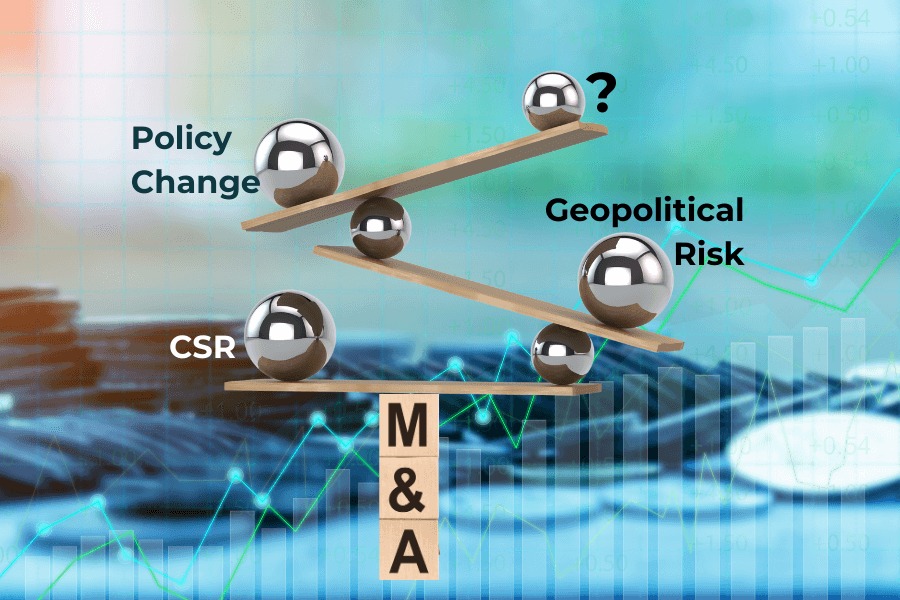
Domestic mergers and acquisitions (M&As) have become one of the major ways firms respond to persistent uncertainty. Between 2015-16 and 2019-20, many Indian companies increasingly turned inward, preferring domestic targets to cross-border expansion. This shift is not only a strategic response to risk, but also a test of institutional design. Can commitments meant to promote corporate responsibility – most notably, India’s mandatory corporate social responsibility (CSR) regime – also preserve the flexibility firms need for consolidation when conditions are volatile?
That question matters because uncertainty is no longer episodic. Border tensions, regulatory activism, policy reversals, and global supply chain realignments have combined to reshape how firms plan growth. In India, this strategic shift unfolds under a fixed statutory obligation: mandatory CSR spending is tied to profits, regardless of business cycles or restructuring needs. While substantial attention has been paid to each of these forces in isolation, how they interact – when domestic consolidation has become increasingly crucial to India’s industrial and economic strategy – remains relatively under-examined.
Risk as a Constant, Not a Shock
Geopolitical risk forms a persistent backdrop to corporate decision-making. Measured across political, conflict-related, and policy dimensions, risk levels during the latter half of the 2010s consistently sat above the midpoint on a ten-point scale, signalling pressure rather than panic.
Firms respond differently to such conditions than to short-lived shocks. Short, unexpected disruptions typically lead to postponed or abandoned transactions. Persistent uncertainty, by contrast, alters strategy. As uncertainty increases, domestic M&As in India tend to become more viable than cross-border ones. Domestic deal failures decline when risk increases, suggesting that firms treat domestic consolidation as a stabilising strategy. Familiar legal systems, absence of foreign exchange exposure, and fewer approval layers make domestic transactions comparatively frictionless when the external environment becomes harder to read.
Crucially, whether such deals succeed or fail carries implications beyond firm balance sheets.
Why Deals Matter Beyond Firms
The success or failure of M&As is not just a corporate concern. Failed deals lock up capital that could otherwise support investment, employment, or capacity expansion. There are fiscal implications too. More than half of the acquiring firms during the 2015-20 period belonged to business groups. In periods of stress, such firms often rely on implicit and explicit forms of regulatory and financial system support. When consolidation fails under uncertainty, the resulting liquidity pressures can spill over into the financial system, eventually drawing in regulators and, in extreme cases, the state.
Deal outcomes are, therefore, signals. They reveal whether the policy environment allows firms to adapt to sustained risk, or whether institutional rules quietly constrain adjustment precisely when it is most needed.
Mandatory CSR as an Institutional Signal
India’s mandatory CSR regime, introduced under the Companies Act, 2013, is often framed as an ethical obligation. Firms above a defined threshold must spend 2 percent of their average net profits on approved social activities. Unlike voluntary frameworks elsewhere, this obligation is non-deferrable and cash-based. It functions as a fixed claim on profits, largely insulated from business cycles or strategic transitions.
In practice, CSR compliance has varied among acquiring firms engaged in domestic mergers. Some acquirers report no CSR spending, others spend below the statutory threshold, and a substantial share exceed it. On average, spending is clustered close to the mandated level. Importantly, higher CSR engagement on its own appears to support deal completion, signaling high-grade governance quality and long-term intent. Socially responsible firms tend to enjoy greater reputational trust, smoother stakeholder engagement, and easier access to finance.
Seen this way, CSR operates as an institution-building mechanism. It embeds firms within social and regulatory expectations, lowering friction in routine transactions and reinforcing legitimacy. What strengthens credibility in normal times, however, can have different effects when uncertainty becomes persistent.
When Two Stabilising Forces Collide
The tension emerges when high CSR commitments coincide with elevated geopolitical risk. Each factor independently supports deal stability. Together, they can undermine it.
M&As are short-horizon, liquidity-sensitive processes. Negotiations often require rapid adjustments to valuation, payment structures, or timelines as new information emerges. Under heightened uncertainty, firms need financial flexibility. Mandatory CSR spending, however, is a rigid cash outflow. It cannot be easily postponed or reallocated, even when cash buffers matter most.
The effect is economically meaningful. When both risk and CSR spending rise together, deals that would otherwise succeed become significantly more likely to stall. Obligations that enhance credibility over the long term can constrain manoeuvrability in the short run. Responsibility, in this setting, competes with resilience – not in principle, but in timing.
This distinction matters. CSR strengthens long-term trust, while M&As demand short-term liquidity. When uncertainty is persistent, misalignment between the two can quietly erode the very consolidation that risk conditions make attractive.
Uneven Burdens Across Firms and Sectors
These frictions are not evenly distributed. At the firm level, standalone firms benefit most from domestic consolidation when risk rises. Lacking access to internal capital markets that exist within business groups, scaling up through acquisition can be critical to their survival. Yet they are also the most exposed to CSR rigidity. Without group-level liquidity buffers, mandatory spending can tip negotiations from M&A completion to failure precisely when scale matters most.
Sectoral differences sharpen the picture further. In financial-sector M&As, geopolitical risk plays a limited role, reflecting strong regulatory oversight and stabilisation mechanisms. Here, CSR continues to support deal completion by reinforcing trust in institutions where reputation is critical. In non-financial sectors exposed to supply disruptions or regulatory intervention, CSR rigidity bites hardest during periods of unrest or policy action rather than routine political uncertainty.
Designing Flexibility Without Diluting Intent
The policy challenge is one of design rather than direction. Mandatory CSR has expanded corporate participation in social development and improved transparency. Weakening the commitment would risk undermining these gains. But treating CSR spending as entirely inflexible can impose unintended costs when consolidation supports economic stability.
A limited, rule-based timing flexibility offers a middle path. Transparent deferrals during clearly defined high-risk periods would preserve the 2 percent principle while recognising liquidity stress. Linking such flexibility to deal completion or post-M&A performance could prevent misuse. At the regulatory level, explicitly accounting for CSR pass-throughs in priority sectors would align social objectives with consolidation pipelines rather than placing them at odds.
Institutional awareness matters as well. Integrating systematic risk indicators into corporate oversight would allow regulators to anticipate periods when firms are likely to face compounded pressures, rather than responding after deals collapse.
Responsibility and Resilience in an Age of Uncertainty
For corporate boards, the lesson is strategic. CSR cannot be treated as a static compliance exercise, detached from treasury planning or growth strategy. Its role shifts across the cycle, strengthening trust in stable times and constraining flexibility under stress. Recognising this dual role is essential in an economy where uncertainty is persistent rather than exceptional.
For policymakers, the implication is broader. As India seeks to build resilient firms and national champions, institutional design matters as much as incentives. Responsibility and scale need not conflict. But when rules ignore timing, they can quietly undermine the consolidations that risk conditions necessitate.
In an era of permanent uncertainty, the real test of policy is not whether it promotes responsibility or growth, but whether it allows firms to pursue both across different conditions.