



If recent estimates are accurate, the monetised value of premature mortality from outdoor air pollution in 2022 stood at roughly 9.5 percent of GDP, using standard value-of-statistical-life methods. That is larger than many of the trade shocks we routinely describe as existential threats.
Yet the Union Budget continues to treat clean air as a peripheral environmental item rather than as core economic infrastructure. Air pollution’s economic impact is economy-wide: reduced labour productivity, higher healthcare costs, lower learning outcomes, and chronic disease burdens that accumulate over time. If growth strategy ignores these economy-wide effects, India risks misidentifying its binding growth constraints.
Growth without Breathable Cities is Fragile
India’s rise in global GDP rankings is real. But GDP aggregates do not capture whether daily life is becoming more productive or more compromised. An economy can grow larger even as its workforce bears rising disease burdens and its children face sustained cognitive setbacks from chronic exposure to PM2.5.
If the demographic dividend is to translate into sustained productivity gains, the baseline conditions of health must be protected. Chronic exposure to polluted air erodes that foundation long before it appears in headline mortality data. Unlike tariffs, dirty air quietly weakens classroom concentration, workplace attendance, and long-term health.
Recent India-focused evidence shows that these channels are not abstract. Studies using data from the India Human Development Survey (IHDS) associate higher PM2.5 exposure with weaker reading and math scores and lower school attendance. Other research exploiting natural variation in exposure finds adverse effects on children’s cognitive and academic outcomes. On the labour side, micro-studies in Indian workplaces find that higher pollution is linked to lower daily productivity – a direct drag on human capital.
The Political Economy of Exit
Pollution also reshapes incentives in ways that weaken reform coalitions. When public goods deteriorate, those with resources increasingly exit rather than voice concerns. Private healthcare, air purifiers, and geographic mobility become substitutes for public provision.
Recent wealth migration estimates suggest sustained outflows of high-net-worth individuals in recent years. The Henley Private Wealth Migration Report projected a net outflow of about 4,300 millionaires in 2024, compared to 5,100 in 2023, and a further projected net outflow of about 3,500 in 2025. While these reports do not attribute migration primarily to air pollution, research shows that degraded environmental quality can influence out-migration decisions, often more strongly among higher-skill groups, with measurable productivity consequences for the places they leave.
The broader point is structural: when those with influence move out, the political pressure to fix shared public goods weakens. Pollution thus becomes not only an environmental failure but a state-capacity test.
What the Budget Signals
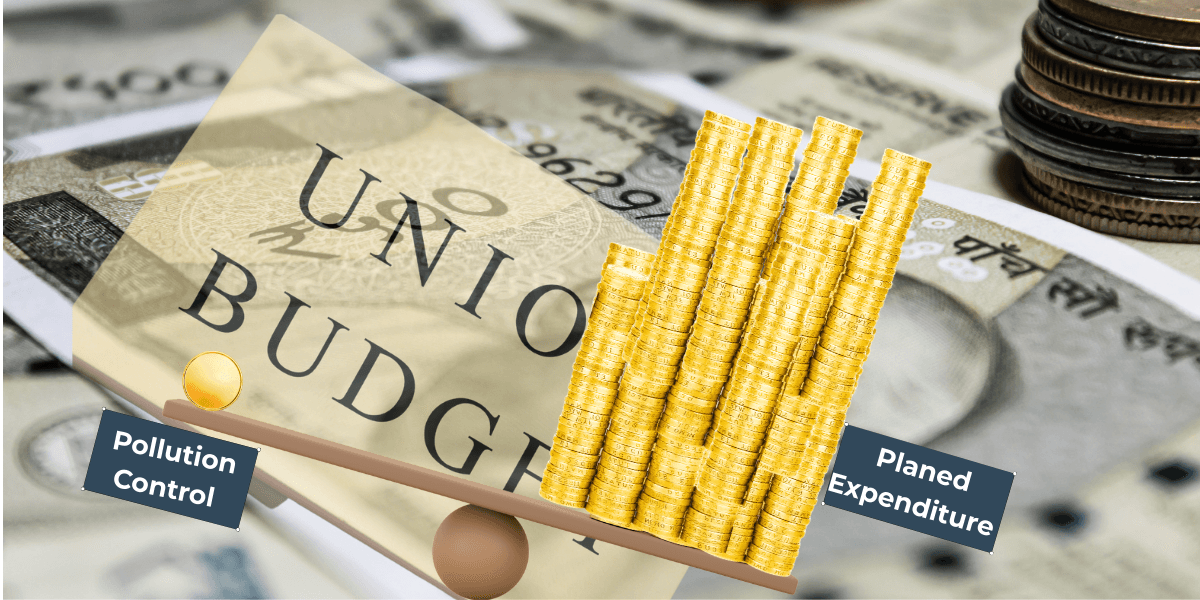
The Budget makes priorities visible. This year’s allocation of approximately ₹1,091 crore toward pollution control boards and the National Clean Air Programme (NCAP) suggests continuity rather than a meaningful escalation in priority. In 2026–27 (Budget Estimate, BE), the outlay is 16 percent lower than 2025–26 (Revised Estimate, RE) (₹1,300 crore), even though it had been revised up sharply from the 2025–26 (BE) of ₹854 crore. That pattern matters. An upward in-year revision followed by a lower Budget Estimate suggests reactive adjustment rather than sustained prioritisation.
Within the Ministry’s total outlay (₹3,759 crore in 2026–27), “Control of Pollution” accounts for about 29 percent. Within the Union Budget’s total expenditure (₹53,47,315 crore in 2026–27 BE), it is roughly 0.02 percent. When an economic drag of this magnitude occupies such a marginal share of national expenditure, it suggests that air quality remains treated as compliance spending rather than as growth-enabling investment.
The same documents also flag implementation weakness, with 2024–25 spending reported (as per budget documents) at ₹16 crore against ₹859 crore (BE). That gap is not merely administrative. It points to weaknesses in implementation, inter-agency coordination, and incentive alignment.
From Seasonal Emergency to Performance Metric
Air quality governance in India remains episodic, often activated during winter spikes in specific cities and framed as a seasonal emergency rather than as a sustained economic constraint. That framing obscures the fact that pollution exposure is a year-round drag on productivity and human capital.
If clean air is to be treated as economic infrastructure, governance must shift toward measurable annual performance benchmarks. Cities should be evaluated on sustained reductions in annual average PM2.5 levels, not only on episodic AQI spikes. Reporting must be transparent and allow comparison across jurisdictions and over time.
Monitoring, however, is insufficient without enforcement. Persistent compliance gaps in construction dust control, waste burning, industrial fuel transitions, and vehicle inspection regimes indicate that regulatory follow-through remains uneven. Funding flows should be linked to outcomes, through transparent city-level scorecards tied to fiscal transfers or programme allocations. At the same time, predictable multi-year financing commitments for clean transport, dust mitigation, industrial fuel switching, and household energy transitions would embed air quality policy within long-term infrastructure planning.
One option is a Finance Commission–linked Clean Air Performance Grant: a ring-fenced urban transfer to states and urban local bodies. Allocations and tranche releases could be tied to verified year-on-year reductions in annual PM2.5, expanded monitoring coverage, and audited compliance on dust control, waste burning, and industrial and transport emissions. Disbursements could be tranche-based against a transparent state or city scorecard, with third-party verification to limit misreporting and reward sustained year-round outcomes rather than seasonal crisis response.
Without these shifts, pollution will continue to be treated as a recurring emergency rather than as a structural growth constraint. Treating clean air as a measurable performance metric within fiscal architecture and urban governance would signal that breathable cities are not an environmental add-on, but a foundational economic priority.
The Next Growth Reform Is Clean Air
India’s rise in GDP rankings is a milestone, but the durability of that rise will depend on what the fiscal state chooses to treat as infrastructure. As cities expand and the demographic window narrows, underinvestment in air quality risks locking productivity losses into the growth model itself.
The next phase of India’s development will be defined less by tariff negotiations abroad than by whether its fiscal architecture embeds breathable cities as a core condition of growth.