



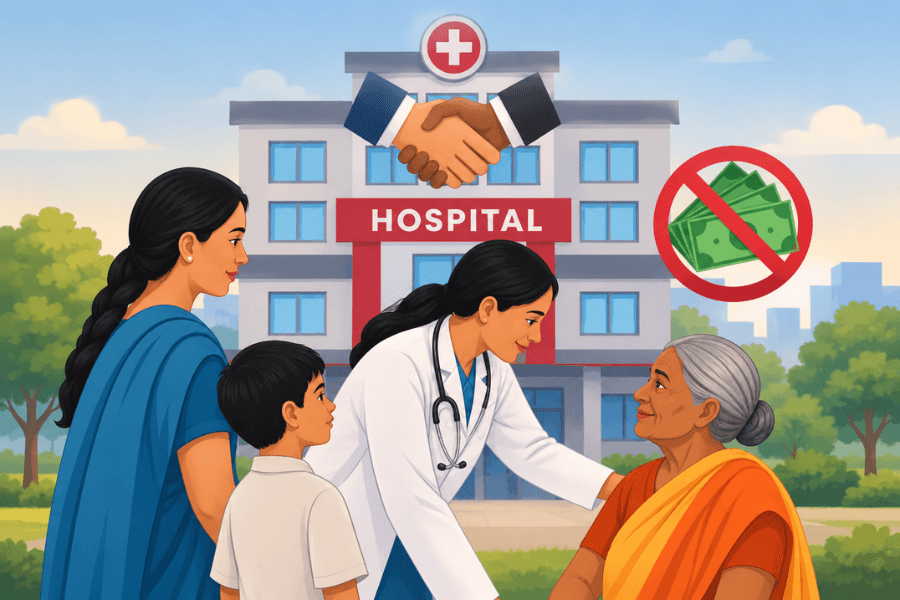
India’s uninsured “missing middle” exposes a significant gap in the country’s health-financing arrangements. NITI Aayog estimated this population at around 400 million in 2021, comprising households without private health insurance that also fall outside subsidised public insurance arrangements. This gap leaves households exposed to medical costs they may be unable to absorb.
When hospital bills exceed available resources, families may borrow, sell assets or seek financial support from others. Such measures help meet immediate treatment costs but can undermine future economic security. The policy challenge is to expand insurance coverage in ways that prevent illness from forcing households into financial distress.
Why the Missing Middle Remains Exposed
India’s health insurance arrangements rely on publicly subsidised schemes, employer-linked coverage and private voluntary insurance. Public schemes such as Ayushman Bharat–Pradhan Mantri Jan Arogya Yojana (AB-PMJAY) principally support eligible vulnerable households, while private insurance depends on the ability to pay premiums. NITI Aayog’s 2021 assessment identified self-employed agricultural workers, informal-sector workers and households outside organised employment as important segments of the missing middle. Their employment arrangements often provide neither employer-sponsored coverage nor a reliable route to contributory insurance.
Affordability remains a major constraint. NITI Aayog estimated that premiums for available private insurance products could be two to three times what large sections of this population could afford. Even standardised products such as Aarogya Sanjeevani face affordability and coverage limitations, including waiting periods and co-payments.
Serving dispersed informal-sector and self-employed households raises insurers’ acquisition costs, while irregular incomes can make continuous coverage difficult.
Even where insurance is available, its protection may be incomplete. Hospitalisation-focused policies often leave households bearing the costs of consultations, medicines, diagnostics and continuing treatment. The Parliamentary Standing Committee on Health and Family Welfare, in its August 2026 report, highlighted these gaps alongside concerns over premiums, exclusions, waiting periods, co-payments and claim settlement. Coverage gaps are therefore compounded by the limited financial protection some insurance arrangements provide.
When Medical Expenditure Becomes Financial Distress
The consequences of inadequate protection become particularly visible when hospitalisation costs exceed what households can meet from their own resources. One measure of this pressure is catastrophic health expenditure (CHE), defined here as out-of-pocket medical spending exceeding 10 percent of annualised household consumption expenditure.
An analysis of 36,610 hospitalised individuals identified as part of the uninsured missing middle in the 2017–18 National Sample Survey's 75th-round Social Consumption: Health survey found that those experiencing CHE had a 23.8-percentage-point higher probability of resorting to distress financing, after accounting for observed household and individual characteristics. The missing-middle sample was approximated using household expenditure categories and reported insurance status, rather than direct verification of public-scheme eligibility. The findings establish a substantial association, although the survey's cross-sectional nature does not establish causality.
Financial distress was evident across both public and private healthcare settings. Among patients experiencing CHE, the estimated probability of resorting to distress financing was 57.7 percent for those using public or NGO hospitals and 51.7 percent for those using private hospitals.
These estimates do not establish that private healthcare offers greater financial protection, since patients using different facilities may differ in their economic circumstances, treatment needs and access to credit. They show, however, that financial distress persists even among patients using public facilities. Although the 2017–18 survey predates subsequent changes in insurance coverage, the findings illustrate why access to treatment and protection from its financial consequences must be assessed separately.
From Insurance Enrolment to Effective Financial Protection
Closing the financial protection gap requires changes in how households are enrolled, how medical risks are pooled and which costs are covered through insurance and public healthcare provision.
First, financing arrangements must reflect differences in households’ capacity to contribute. Households with limited resources may require substantial public subsidies, while those able to pay part of a premium could participate in contributory arrangements. For informal-sector workers and self-employed households, enrolment through occupational associations, cooperatives and other membership-based networks could reduce administrative costs and improve participation. Flexible contribution and renewal arrangements would also help accommodate irregular incomes.
Lower enrolment costs alone, however, will not ensure sustainable insurance. Voluntary participation may produce uneven risk pools concentrated among households anticipating treatment. Contributory models must therefore balance affordable premiums, public subsidies and broad participation.
Second, effective insurance coverage must be evaluated by the financial protection it delivers, not enrolment alone. Premium affordability matters, but so do exclusions, co-payments, waiting periods, claim settlement and the expenses households must bear after receiving treatment. The Parliamentary Standing Committee's proposals for affordable standardised insurance products, shorter waiting periods and outpatient benefits provide directions for reform. Their effectiveness, however, will depend on whether households can obtain treatment without incurring unaffordable costs.
This requires a broader approach to measuring programme performance. Alongside enrolment, claims and settlement indicators, policymakers should examine out-of-pocket spending, the incidence of catastrophic health expenditure and households’ reliance on distress financing. Tracking these outcomes would help establish whether insurance expansion is translating into greater economic security rather than simply increasing the number of people formally covered.
Third, financial protection must extend beyond hospitalisation. Consultations, medicines, diagnostics and continuing treatment can impose recurring costs even when hospital admission is avoided or has ended. Insurance and public healthcare provision have complementary roles: insurance can pool the risk of substantial medical costs, while reliable public provision of essential medicines, diagnostics and outpatient services can reduce expenditure that households must meet directly.
Improvements in the availability and quality of public healthcare must accompany insurance expansion. Greater transparency in provider charges and billing would also help patients anticipate and scrutinise treatment costs.
The ultimate measure of health-financing reform is whether households can obtain necessary treatment without borrowing, selling assets or compromising their future economic security.