


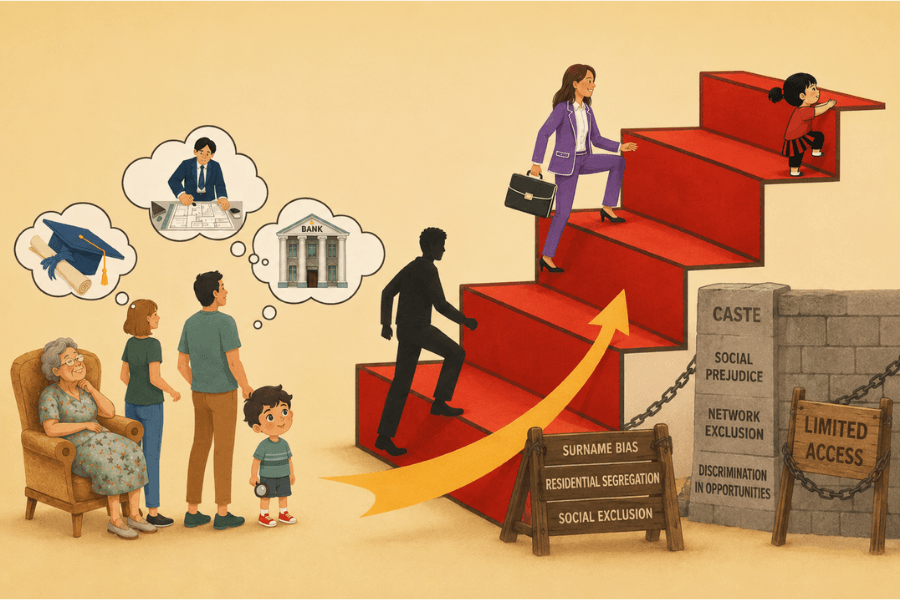
Much of India’s anti-discrimination architecture was designed to address exclusion from opportunity. Expanding access to education, employment, and public institutions therefore became the central policy objective.
Those efforts have produced meaningful gains. Yet the defining challenge today is not simply access, but whether households can translate access into sustained upward mobility across generations. In urban India, where outright exclusion appears less central than before, the persistence of relative disadvantage and limited intergenerational mobility has become increasingly important.
How Disadvantage Reproduces Itself
Understanding why some households remain disadvantaged across generations therefore requires examining the mechanisms through which inequality is reproduced. This is where caste disadvantage continues to exert a powerful influence.
Economic mobility is not determined by a single labour-market outcome. The opportunities available to one generation help shape the opportunities available to the next. Lower earnings today can mean lower investments in education, fewer opportunities to accumulate assets, and reduced capacity to support children's advancement. Over time, these differences compound.
Social status can reinforce this process. Families with greater economic resources and social standing are often better positioned to access networks, information, and marriage matches that help preserve or strengthen their advantages. Conversely, economic disadvantage can limit access to these opportunities, increasing the likelihood that disadvantage is reproduced across generations.
As a result, caste-linked disparities do not end with a single generation's labour-market outcomes. They can influence the resources, opportunities, and social position inherited by future generations, shaping long-term mobility trajectories.
Different Disadvantages, Different Outcomes
Consider three societies: a benchmark society in which caste plays no role in economic outcomes; a second society which faces caste-linked barriers to accessing high-paying occupations; and a third society with equal access to occupations but lower rewards for disadvantaged-caste households within those occupations.
Across these societies different forms of discrimination leave different footprints on economic mobility. Barriers to access primarily shape who enters higher-paying occupations and how households are distributed across economic classes. Unequal rewards refer to differences in the economic returns households receive after entering occupations, including earnings, consumption, asset accumulation, and economic security. By shaping living standards within economic classes, these differences also affect the ability to sustain upward mobility across generations.
A simulated model, calibrated against PLFS 2025 data suggests that contemporary urban India reflects both of the mechanisms outlined above: barriers to accessing higher-paying occupations and unequal rewards within those occupations. Mobility patterns resemble a society characterised by barriers to access, while differences in consumption and living standards resemble a society shaped by unequal rewards. This suggests that entry into opportunity and rewards from opportunity remain distinct dimensions of disadvantage.
More importantly, reward disparities appear to generate larger opportunity losses than access barriers alone. The estimated lifetime opportunity available to disadvantaged households falls from about ₹80.7 lakh under access barriers to roughly ₹71.4 lakh under unequal-reward conditions, compared with ₹98.8 lakh for advantaged households.
As access expands, disparities in rewards become increasingly important in shaping long-term mobility outcomes.
Persistence Across the Economic Hierarchy
The consequences of these mechanisms are reflected in the extent to which households move – or fail to move – across economic strata over time.
Disadvantaged-caste households face a significantly higher probability of remaining trapped in lower economic strata, at 61.7 percent, than 47.5 percent for advantaged households. Compared with a society free of caste-linked disadvantage, the share of households reaching the highest economic strata is about 11.3 percentage points smaller.
This points to a broader pattern in which caste hierarchy is reproduced from both ends. Disadvantaged-caste households are more likely to remain concentrated in lower economic positions, while advantaged-caste households are more likely to retain their position near the top. The result is not simply immobility at the bottom, but persistence throughout the economic hierarchy.
Matching Metrics to Mechanisms
If different mechanisms reproduce inequality in different ways, they cannot be assessed using the same yardsticks. The implication for policy is straightforward: interventions should be evaluated according to the mechanisms they are designed to change.
Policies aimed at expanding access should be assessed through indicators of representation, progression, and mobility. These measures capture whether opportunity structures are becoming more inclusive and whether individuals are able to advance through them. By contrast, policies aimed at addressing unequal rewards should be evaluated through indicators such as earnings, economic security, and living standards, which reflect whether access is translating into tangible economic gains.
Effective policy requires matching interventions to mechanisms and matching metrics to objectives. As the nature of disadvantage evolves, the frameworks used to diagnose and evaluate it must evolve as well.