

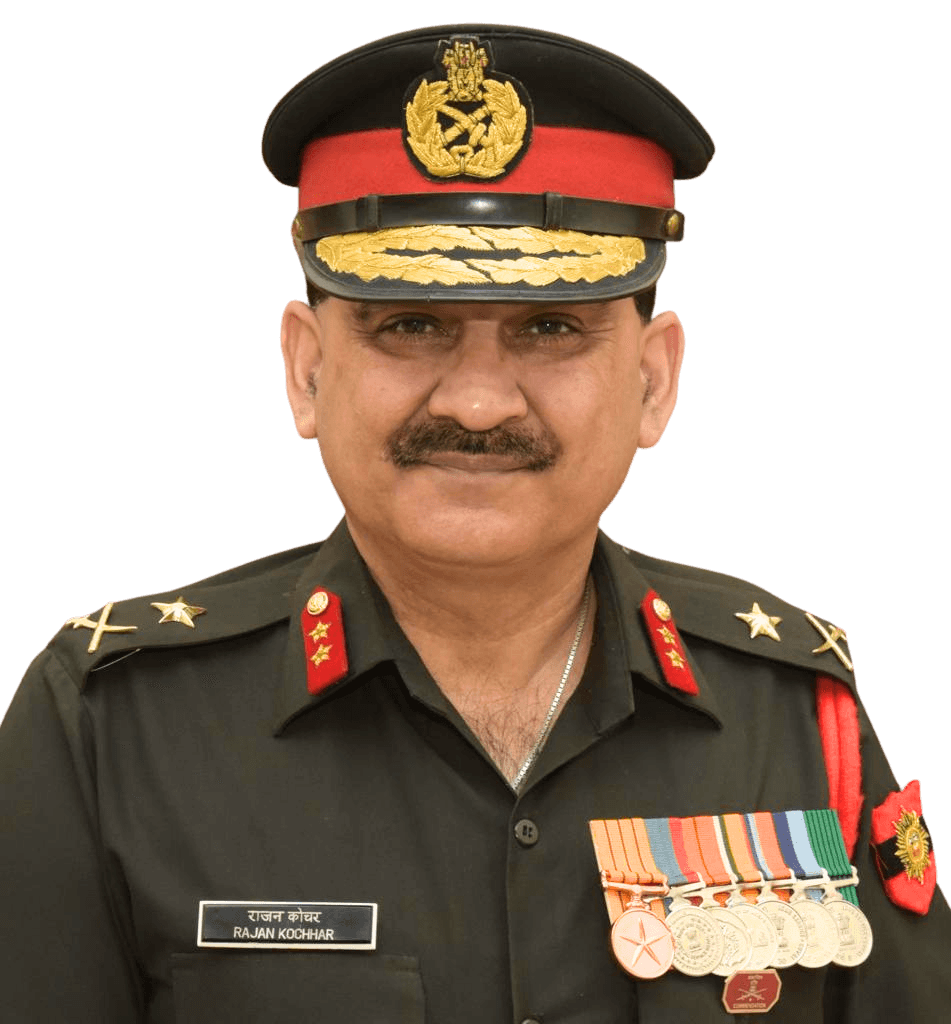
In this conversation with The Policy Edge team, Dr. Kochhar reflects on public policy through the lens of military experience, examining why reforms falter at scale, how institutional memory is designed, and what defence practice reveals about sequencing, implementation, and state capacity in civilian governance.
You have served in the Army for over three decades and been active in policy, advisory, and expert roles since then. From what you have seen across military and civilian institutions, what distinguishes public policies that work from those that fail once they meet real-world systems?
Most public policies fail not because governments lack intent or expertise, but because they are designed without sufficient attention to systems – how people, institutions, incentives, and capacities interact in practice.
Policies that work begin with clarity on the end state: what must be demonstrably different once the policy has matured. From there, decisions need to be sequenced deliberately – defining objectives, setting terms of reference – what the policy will and will not try to do. Equally important is identifying fault lines in the existing system – whether in capacity, incentives, or coordination – and then generating options and evaluating trade-offs before deciding on implementation.
When these steps are skipped, execution is quick, but implementation risk expands. Policy design must therefore ask what the system can realistically absorb without breaking, balancing political urgency against administrative capacity.
In your experience, what tends to break first – training capacity, supervision, or institutional discipline – when governments attempt nationwide public reforms at speed? And how can policymakers hedge against these risks?
Speed almost always breaks training capacity first, supervision soon after, and institutional discipline more gradually. When reforms are rushed, governments tend to assume that systems can absorb change. In practice, training infrastructure, instructors, and administrative bandwidth are limited in the short run and rarely scale in step with ambition.
Once training capacity is stretched, supervision begins to fray. Managers who should be monitoring quality and compliance are pulled into managing shortfalls. Over time, this erodes institutional discipline – the capacity to apply standards consistently at scale. What begins as a capacity strain eventually becomes a governance problem.
Moving fast may generate immediate political momentum, but it often imposes deferred costs that surface through repeated corrections. The challenge, therefore, is not speed itself, but calibrating design carefully enough to allow learning before commitment hardens.
This is where pilots and phased rollouts matter. They expose stress points early, when course correction is still affordable, and reveal which assumptions about scale, behaviour, incentives, and capacity do not hold in practice.
Seen this way, a pilot is not an admission of uncertainty. It is a recognition that learning is far cheaper at small scale than after nationwide rollout, and that durable reform depends on preserving institutional control as change is absorbed.
The Agniveer Scheme was framed as a structural reform to manage pension liabilities and modernise force composition. From a systems-design perspective, what does it reveal about large recruitment reforms in the public sector?
The Agniveer scheme is a useful case study because its fiscal objective was explicit, but the organisational and social end-state was less fully articulated. Reducing long-term pension liabilities was its primary goal. What received less attention was how personnel flows, training capacity, and post-exit pathways would interact once the system moved from design to scale.
The problem becomes clear when one looks at the numbers. Prior to the reform, the armed forces were seeing roughly 60,000 retirements annually. Initial recruitment under the new scheme was closer to 45,000 a year, with only 25 percent retained after four years. That meant an effective annual retention of about 11,250 personnel, creating a net shortfall of nearly 49,000 each year. This is not a marginal imbalance; it is a gap that compounds over time.
A related misalignment lay in training capacity. Training establishments were designed for an annual intake of around 60,000 recruits, with training cycles of roughly 11 months. Under Agniveer, intake was later increased to nearly 1,00,000, even as training duration was compressed to six months. Infrastructure, instructor strength, and supervision ratios were not redesigned at the same pace. This mismatch between capacity and intake overstretches supervision and training quality.
Finally, exit pathways for the 75 percent leaving after four years were not integrated into the original design. Severance pay was treated as a sufficient bridge, while absorption pathways into other forces or civilian employment were clarified only later, and partially. Releasing trained cohorts at scale without predictable pathways shifts risk from the organisation to society, and eventually back to the state.
These are very interesting observations. While speed and scale exposes hidden capacity limits, what happens when they receive pushbacks – sometimes quiet, sometimes visible? From your experience, what do these pushbacks usually signal, and how do they add up into the policy itself?
Early pushbacks are rarely ideological. More often, they are the system’s first signal that assumptions made during design are colliding with operational reality. These signals may appear quietly – through uneven implementation, workarounds, or declining quality – or more visibly through complaints, delays, or public unease. In either form, they point to downstream effects that were not fully anticipated.
The situation becomes more difficult when unclear thresholds, or uneven rules are hard-coded into the policy. Frontline administrators are then forced to exercise discretion repeatedly just to keep the system moving. While this may resolve individual cases, at scale it produces inconsistency and gradual erosion of trust.
Good policy design avoids this trap by keeping rules clear and defensible, while allowing judgment at the margins. Seen this way, early pushbacks are not obstacles to reform; they are diagnostic signals that help prevent operational stress from hardening into systemic failure.
To a large extent, what you have described depends on institutional memory. Frequent transfers are common in both the armed forces and civilian administration. Why, then, does institutional memory persist more effectively in the armed forces than in civilian systems?
In the armed forces, institutional memory is designed into the transfer process itself. While officers are transferred frequently, transitions are structured around overlap and accountability. Incoming officers arrive before the outgoing ones depart, and a mandatory handover period – typically 4 to 7 days – is built into the process.
These handovers are formal and enforceable. Detailed written notes record decisions taken, constraints encountered, and work left unfinished. They are signed by both officers and countersigned by the next higher authority. Subordinates also certify, in writing, that there are no discrepancies in accounts, stores, or operations. Once signed off, this information becomes part of the institutional record
This design alters incentives. Responsibility does not end with a transfer, and there is little scope for selectively forgetting past decisions. In civilian administration, by contrast, transfers often occur without structured overlap or enforceable handovers. Knowledge then moves with individuals rather than staying with the institution. Institutional memory, therefore, is not a cultural trait; it is an outcome of administrative design.