



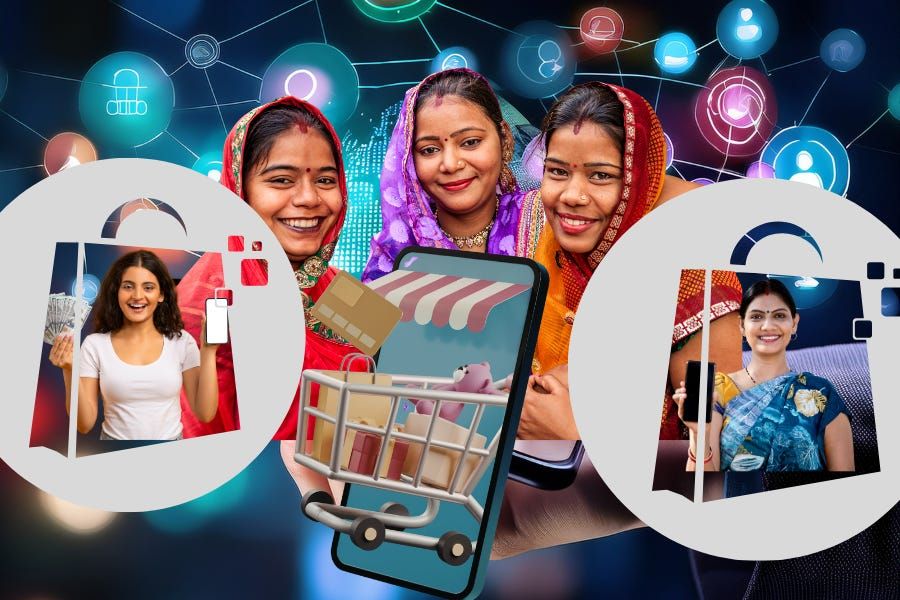
The rise of social commerce – small businesses run through personal social media accounts – is one of the most consequential shifts of the past decade. It has reshaped entry into India’s labour market, creating a flexible, low-cost pathway into entrepreneurship for women long excluded from formal work. WhatsApp groups now function as bazaars, Instagram pages as boutique storefronts and Facebook Live as a tool for real-time demonstrations.
This fast-growing universe of women-led social commerce occupies an economically vibrant but structurally exposed space. The rules that govern online safety and accountability – from protections against harassment to mechanisms for addressing payment fraud – do not extend to informal sellers operating through personal accounts. They were built for formal e-commerce platforms with structured transactions and traceable records. This legal invisibility increases vulnerability, which in turn suppresses both participation and growth.
Why Women Turn to Social Commerce, and Vulnerabilities
Mobility, credential and capital constraints keep many women out of the formal labour force. Barely 4 in 10 Indian women are economically active, and most work in informal roles. Social commerce provides an alternate entry point: with minimal capital, women can work from home, sidestep social scrutiny and reach customers well beyond their locality – producing a quiet but meaningful expansion of economic independence.
Women selling through personal accounts gain visibility, but it also exposes them to unprotected forms of risk. Many encounter inappropriate remarks during livestreams, promotional posts and customer interactions. Payment frauds are equally prevalent. A seller in Rajasthan recently shipped goods after receiving a fabricated digital payment screenshot, only to learn that her informal enterprise was not recognised as a commercial activity when she tried to report the fraud. Such incidents show that digital risks become binding barriers when sellers lack recognised commercial status.
As a result, informal women entrepreneurs must navigate harassment, impersonation, non-payment and misuse of personal data without the protections that accompany formal commerce.
Why Social Commerce Matters
More than a million women sell through curated programmes such as Amazon Saheli and Flipkart Samarth, yet they represent only a fraction of the much larger universe of informal sellers operating through personal accounts. These micro-enterprises widen local consumption, generate steady demand for last-mile delivery, and deepen the everyday use of digital payments across smaller towns and cities. Supporting this wider segment can advance women’s financial inclusion, stabilise household incomes, and strengthen their foothold in India’s digital marketplace.
A safer and more predictable social-commerce environment would amplify these gains at scale by expanding demand for platform services, verification tools and logistics innovation. These ripple effects make clear that addressing vulnerabilities is not only a matter of gender equity but of market efficiency and economic performance.
A Policy Framework Lagging Behind
India’s digital laws – the Information Technology Act, the Consumer Protection (E-Commerce) Rules and the Digital Personal Data Protection Act – have strengthened regulation for large, platform-mediated transactions. They impose obligations on companies, mandate grievance mechanisms and safeguard consumer interests. But informal social commerce sits largely outside these frameworks.
For most women sellers, this regulatory gap has real consequences. Many are not registered under MSME norms, fall below GST thresholds and lack the documentation needed to pursue complaints as commercial entities. Harassment is treated as a “personal” inconvenience rather than a barrier to economic participation, while fraud becomes harder to pursue when the transaction itself is not recognised as commercial activity.
International observers, including UNESCO, note that when digital governance does not account for gendered experiences, online platforms can reinforce – and sometimes deepen – existing inequalities, underscoring the urgency of closing India’s regulatory gap.
Building Digital Trust
Building trust in social commerce does not require new institutions or heavy compliance. It requires extending existing tools to informal sellers in the digital economy, so that opportunity and protection grow together.
A simple, voluntary recognition mechanism would allow informal sellers to access basic safeguards under existing law. India’s Udyam Registration reform – which saw MSME enrolment rise sharply once the process moved fully online – shows how low-friction identification can broaden participation. Extending similar ease to women selling through personal social media accounts would unlock a substantial pool of entrepreneurial potential and provide the legal visibility needed for protections to attach to their transactions.
Digital literacy and safety programmes also need a sharper focus. Many women have learnt to sell online but remain unfamiliar with privacy controls, secure payment practices or grievance procedures. The Pradhan Mantri Gramin Digital Saksharta Abhiyan (PMGDISHA), which has trained more than 60 million citizens in basic digital skills, demonstrates the scale India can achieve. Tailoring this training to social-commerce risks would help more women participate with confidence.
Clearer coordination between platforms, state cyber cells and the National Commission for Women would provide more predictable avenues for reporting harassment or fraud. Joint cyber helplines in several states have already improved response times for digital payment disputes. Adapting these models to the needs of women in social commerce would create a more reliable and responsive safety net as the sector grows.
The Road Ahead
India’s next digital transition will depend on extending basic legal visibility to the millions of women who sell through personal social-media accounts. This single reform could turn today’s informal micro-enterprises into secure economic actors. Other improvements – safer transactions, better platform infrastructure, and more reliable market participation – will follow as byproducts. The question is no longer whether women are part of India’s digital economy, but whether policy will give them the protections needed to remain there and grow.