

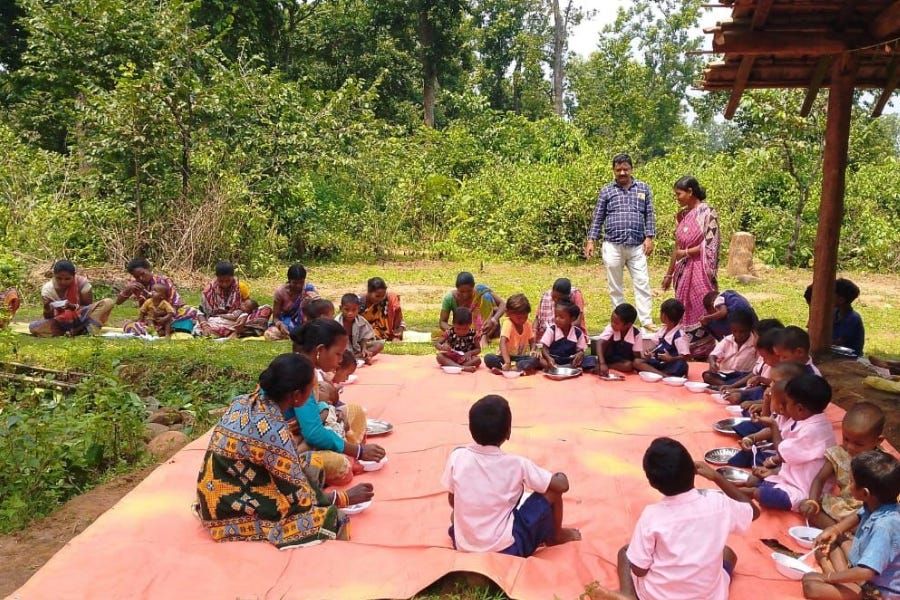
When Ramesh Sahu entered Odisha’s development sector over a decade ago, it was through remote hamlets rather than policy seminars. His early fieldwork with Particularly Vulnerable Tribal Groups (PVTGs) – small indigenous communities with limited access to state services – shaped how he understood implementation. Years later, as a Program Manager with the Azim Premji Foundation’s Community Nutrition Programme, that grounding continues to define his philosophy.
“I learnt early,” he says, “that policy isn’t real until it reaches the last house in the last habitation.”
His public writing often frames his work as “learning from the last village how the system should work for the first,” and the Pada Pushti Karyakram (Hamlet-Based Feeding Programme) emerged from that sensibility.
A Three-Minute Video That Exposed a Blind Spot
Muniguda in Odisha’s Rayagada district made the problem vivid. Most families in these hamlets are tribal and depend on daily wage labour. Under the Integrated Child Development Services (ICDS), children are entitled to nutrition delivered via local Anganwadi Centres. But the nearest Anganwadi was often three kilometres away – far too distant for a toddler, and too costly for a parent who would forfeit a day’s income to escort them. Many hamlets were also too small to qualify for their own Anganwadi under ICDS norms, which require at least 300 people to sanction a centre.
“These villages weren’t ignored,” Ramesh says. “They were excluded by design.”
Instead of explaining this gap in another meeting, his team filmed the full walk a child would take from one hamlet to the centre and screened it at a meeting of senior officials. He was met with a question “why are you showing this video?”
“We watched a three-year-old walk this much before eating every day,” Ramesh replied, “Distance doesn’t look like a barrier in a meeting room, but it feels like one when you walk it.”
The point landed. Once the Administration mapped the area, it identified over 200 such villages – many effectively outside the ICDS net. What had seemed like a logistical inconvenience now revealed a structural blind spot.
Mothers Lead; the System Follows
When mothers learned that the government already supplied ingredients for hot cooked meals (HCM) under the Supplementary Nutrition Programme (SNP), part of ICDS, they proposed a straightforward solution. They suggested cooking in the hamlet itself, with one mother taking responsibility each day and Anganwadi workers delivering the provisions.
“If the centre cannot come here,” one mother told Ramesh, “at least let the food come here.”
These meals began under trees, on verandas, or in small open spaces. The early days revealed missing basics – mats to sit on, utensils, and handwashing setups. Ramesh experimented with different support models, ultimately discovering that small, consistent material support was far more reliable than cash transfers or pooled funds. As evidence grew, the district integrated this model into its nutrition planning, later supporting it through a special state nutrition fund with ₹2,000 allocated per hamlet.
What began as an improvised community effort gradually entered the government system.
PPK+: When Younger Siblings Shifted the Frame
A quiet shift occurred when three-to-five-year-olds began bringing younger siblings to eat with them. These infants and toddlers were not officially covered by HCM under SNP portions, but their need was obvious.
“If a toddler has walked here,” Ramesh told his team, “We cannot turn them away”. He recalls another moment: “A little girl grabbed a spoonful from her sister’s plate. That showed us the policy window was too narrow.”
The team chose inclusion, covering ration shortages themselves when necessary. This choice evolved into the Pada Pushti Karyakram Plus (PPK+), which ensures that any child who arrives is fed.
Ramesh notes that across the Foundation’s Community Nutrition Programme, 176 PPKs now operate through 135 Anganwadi Centres in four districts, feeding about 1,300 pre-school children daily. Under PPK+, around 1,190 younger children also receive full meals. What began as a response to lived reality has become a scalable model for last-mile inclusion.
Where the Register Stops and Reality Begins
Even as the feeding systems improved, familiar gaps persisted. Some Anganwadi Centres lacked early learning materials or toys. Attendance registers listed fifteen children, but only eight would sit on the floor that day. Enrolment figures were often inflated – names stayed on the list long after children stopped attending – so rations reflected paperwork rather than the real number of children in the hamlet.
“A register cannot feel hunger,” Ramesh says. “The distance between a review table and a hamlet is sometimes longer than the distance between the hamlet and the centre.” He adds.
These gaps mattered not just for nutrition but for early childhood care and the morale of frontline workers who operated with limited support.
From Panchayats Upwards: Designing From the Last Village
Ramesh believes local governance is the missing link in bridging design and delivery. He often remarks, “A Sarpanch has more power than they realise,” noting that even simple monthly Panchayat-level reviews could significantly strengthen monitoring and troubleshooting. While state-level audits are important, they cannot substitute for local attention in remote habitations far from administrative centres.
“Planning must begin from where policy reaches last,” he says.
When design starts with the smallest habitation rather than the district headquarters, delivery stops being a chase. The system meets the child, not vice versa.
From a Forest Hamlet to a State Model
PPK began as a modest pilot in about 120 hamlets in Muniguda. As evidence built up, the Department of Women & Child Development issued directives allowing hamlet-level feeding using state nutrition funds. Ramesh notes that the programme has since expanded to approximately 1,800 hamlets across Odisha, and state reporting identifies over 2,500 “hard-to-reach” villages for such interventions. The model has been recognised by SKOCH Awards – a national platform that honours innovations in governance and social development – and is now part of Odisha’s broader strategy to reduce malnutrition. It is also anchored within the Azim Premji Foundation’s larger health and nutrition engagement, which spans community crèches, health counselling, and community support for frontline Anganwadi workers.
The impact is visible in small but profound ways. Children who once walked miles for a meal now eat safely in their own hamlets. Mothers cook with dignity and shared responsibility. Parents no longer choose between a day’s wages and a child’s nutrition.
From forest trails in Muniguda to policy tables in Bhubaneswar, one idea has remained at the centre of Ramesh’s work: the system fails not because it lacks intention or resources, but because it often begins planning from the wrong end of the map.