



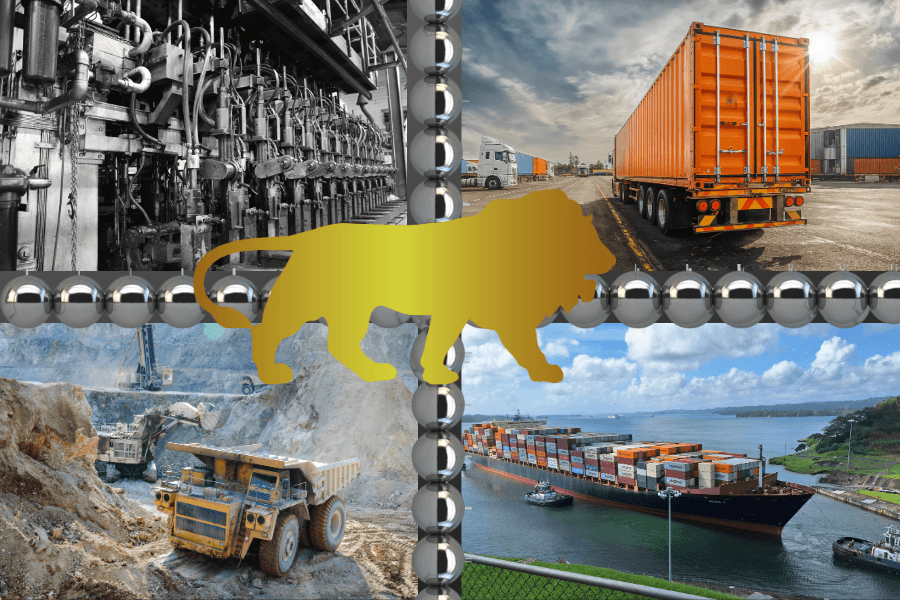
India ranks among the top five countries in rare-earth mineral reserves, yet remains heavily dependent on imports for permanent magnets – the small but critical components that power electric vehicles, wind turbines, and defence systems. This paradox points to a deeper issue: India has treated minerals, manufacturing, and maritime trade as separate policy silos, even though these stages function as parts of a single value chain. The opportunity now is to integrate them into a coherent way of thinking about how critical minerals move from resource to industry to market.
The strategic importance of this integrated view emerges from multiple stages of value addition in the rare earth value chain – segregation of individual elements, their conversion into metals and alloys, and finally their fabrication into permanent magnets. These downstream stages are where economic value, technological capability, and geopolitical leverage are created. Globally, this is where supply chains remain highly concentrated, particularly in China, which dominates not just mining but also processing and magnet manufacturing. The real vulnerability of India – and the global system – is therefore not access to ore, but dependence on a narrow set of industrial chokepoints.
Seen together, these stages point to a Mineral–to–Magnet–to–Maritime (MMM) lens: an organising framework that links resource access, downstream manufacturing, and the logistics through which critical materials circulate.
India’s Structural Trap: Resources Without Reach
India’s experience illustrates what happens when these stages are governed separately rather than as a single system.. The country’s coastal regions host monazite-rich beach sands, which contain rare earths as well as thorium. Because monazite is radioactive, India rightly adopted a security-first approach after independence, restricting private exports and retaining state control.
This ensured sovereignty over a sensitive resource, but it did not translate into coordinated investment across processing, manufacturing, and trade. As a result, domestic downstream capabilities evolved slowly, leaving India dependent on imports of high-value intermediates such as separated oxides, alloys, and finished magnets.
Why India Needs a MMM Lens
What changes the picture is viewing rare earths not as a mining issue, but as an industrial and logistical system. The Mineral–to–Magnet–to–Maritime framework captures this shift. “Mineral” refers not only to extraction but to beneficiation – the process of concentrating useful material from ore. “Magnet” represents the industrial heart of the chain – separation of rare earth elements, conversion into metals, alloying, and sintering, which is the high-temperature process used to make permanent magnets. “Maritime” reflects the fact that rare earths and their intermediates move predominantly by sea, making logistics an inherent constraint on how the value chain functions rather than an external add-on.
A Narrow Window of Opportunity
Recent policy developments create a favourable moment to pursue this integrated approach. Having in place a large-scale permanent magnet manufacturing scheme signals recognition that India must move beyond raw materials into advanced manufacturing. If implemented as part of a broader ecosystem – linking mineral access, processing technology, port infrastructure, and skilled labour – such initiatives can significantly reduce import dependence and strengthen domestic industry.
Regulatory reforms also point in the right direction. Earlier ambiguity in mining and mineral development rules discouraged private investment and delayed exploration and processing capabilities. Clearer frameworks, combined with public-private partnerships, can now attract technology, capital, and scale. The key is to ensure that regulation supports sequencing: exploration feeds processing, processing feeds manufacturing, and manufacturing connects seamlessly to ports and global markets.
Maritime Strategy is Mineral Strategy
When this sequencing reaches the coastline, it becomes a maritime strategy rather than a purely industrial one.
India’s long coastline and port network are not peripheral assets but central to industrial strategy. Ports – that already handle over 95 percent of India’s merchandise trade by volume – are therefore natural locations for mineral processing clusters, where imported ores or domestic concentrates can be converted into higher-value products close to logistics hubs.
Global supply chains for critical minerals stretch across continents, making them vulnerable to geopolitical tensions and shipping disruptions. India’s location at the intersection of major sea lanes offers a strategic advantage. By developing port-anchored processing and logistics hubs, India can position itself as a reliable node in diversified supply chains, not merely for its own needs but also for partners across the Global South.
In practical terms, this reliability depends on how processing and logistics are organised. Designing processing plants, energy supply, storage, and export facilities together reduces costs, shortens distance to supply chain nodes, and improves resilience in a world where maritime routes are increasingly exposed to disruption.
Organised this way, maritime-linked processing becomes not just a domestic asset but a platform for international collaboration.
From Bilateral Deals to Mineral Corridors
International collaboration allows domestic capability to be scaled beyond national resource constraints.. Many countries possess abundant rare-earth deposits but lack advanced processing know-how. India’s long experience with complex minerals, particularly monazite-based systems, gives it valuable technical expertise.
Structured partnerships – linking overseas mining with Indian processing and magnet manufacturing – can create shared value while reducing over-reliance on any single country. Such arrangements transform mineral diplomacy from simple sourcing into industrial collaboration.
A Distinctive Growth Path for India and the Global South
Taken together, this integrated approach reframes India’s development choices. Rather than competing solely on extraction or low-cost manufacturing, India can specialise as a processing and technology hub, where minerals are converted into strategic components and shipped onward through resilient maritime networks. This aligns industrial growth with green technologies, strategic autonomy, and South–South cooperation.
The Mineral–to–Magnet–to–Maritime pathway is not a slogan, but a practical organising logic for India’s next phase of growth.