



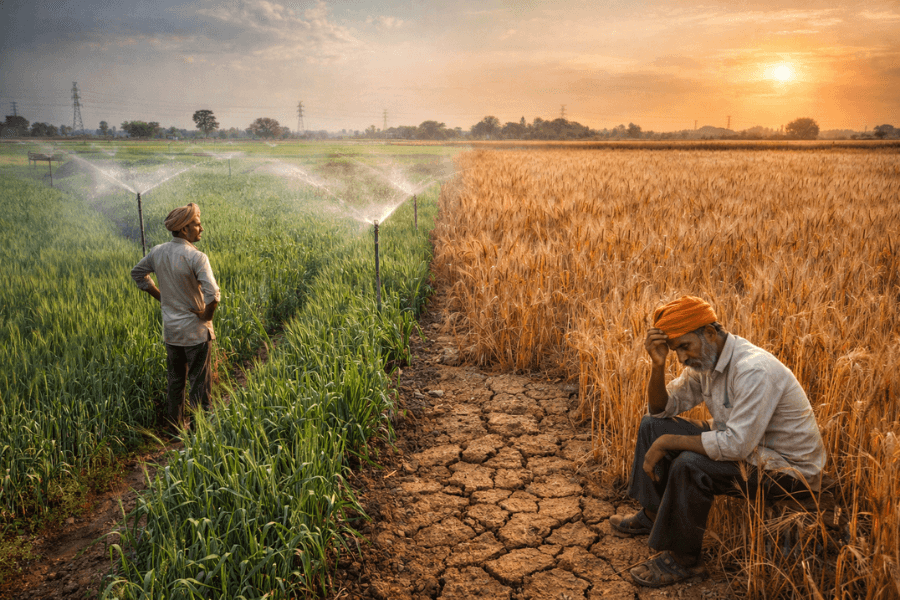
India’s wheat story is usually told as a triumph of the Green Revolution: a once-scarce crop transformed into a stable pillar of food security. What receives less attention is how unevenly this stability is distributed today, and how fragile it has become with rising temperatures and declining groundwater.
This matters because wheat stability is not only an agricultural outcome but also an administrative one. As climate risks intensify, the state’s capacity to manage procurement, buffer stocks, and food distribution depends less on higher average production than on whether wheat behaves as a predictable crop across years and regions.
Irrigation as Risk Management
Irrigation converts wheat from a highly uncertain crop into a more predictable one. Seen this way, irrigation functions as a mechanism for managing risk, in addition to being a tool for raising average output.
Long-run district data from the International Crops Research Institute for the Semi-Arid Tropics (ICRISAT) agricultural statistics, combined with district-level temperature data from the Climate Research Unit (CRU), illustrate this function clearly. In heavily irrigated districts such as Ferozpur in Punjab, wheat yield variability – the extent to which wheat yields fluctuate from year to year after accounting for long-term technological progress and productivity growth – is as low as about 6 percent. In contrast, districts like Guna in Madhya Pradesh experience variability exceeding 50 percent. This difference shapes whether wheat provides farmers with reliable incomes or systematic, recurrent shocks.
For the state, lower variability simplifies procurement planning and reduces the likelihood of emergency interventions. Irrigation, therefore, quietly underwrites not just wheat output, but the predictability of foodgrain management itself.
Regional Inequality in Wheat Stability
The geography of wheat stability closely mirrors the geography of irrigation coverage. North-western India – Punjab, Haryana, and western Uttar Pradesh – operates in near-fully irrigated landscapes where wheat behaves as a relatively secure crop. In these states, irrigation covers more than 90 percent of wheat area in most districts, and yield variability typically remains below 10 percent.
Large parts of Madhya Pradesh, Maharashtra, and Bihar, by contrast, remain exposed to rainfall uncertainty. Here, less than half the crop is irrigated, and yield variability often exceeds 20 percent.
Seen this way, differences in wheat stability reflect less the variations in farming ability or effort, and more the cumulative effects of long-standing uneven irrigation expansion.
Rising temperatures now test how durable this irrigation-led stability is, especially in regions where climatic margins were already thin
Irrigation and Heat Stress: Protection With Limits
As temperatures rise, irrigation does more than smooth rainfall shocks. By maintaining soil moisture, it also reduces heat stress through evaporative cooling. District-level evidence confirms that irrigation weakens, but does not eliminate, the negative effects of warming.
In districts with less than 90 percent irrigation coverage, a one-degree increase in minimum (night-time) temperature is associated with yield losses of about 68 kg per hectare. Where irrigation coverage exceeds 99 percent, losses fall to roughly 29 kg per hectare. A similar gradient holds for maximum temperatures, with losses declining from about 129 kg per hectare per degree to around 83 kg.
This persistence of negative effects even under near-universal irrigation illustrates a clear limit to adaptation. Water can buffer heat stress; it cannot fully neutralise it in already warm agro-climatic conditions. This implies that future yield losses are not only uneven across regions but can be reasonably anticipated, creating a constraint on how far irrigation alone can be relied upon to manage climate risk or stabilise production.
In some settings, the issue is no longer whether irrigation delivers diminishing protection, but whether further expansion can actively undermine productivity.
When Irrigation Becomes Maladaptive
While irrigation expansion continues to deliver gains across most of India’s wheat belt, it does not do so everywhere. In 142 districts – accounting for about 76.5 per cent of India’s wheat-harvested area – short-run increases in the area under irrigation are associated with higher yields. This includes many districts in Madhya Pradesh and Maharashtra, where irrigation coverage of wheat remains relatively modest and the yield response to additional irrigated area remains positive.
However, a small set of districts – four in Rajasthan and one in Bihar – show a negative relationship between expansions in irrigated wheat area and wheat yields. In another set of 28 districts, spread largely across Rajasthan, Madhya Pradesh, and Bihar, yields and expansion of irrigated area show an insignificant relationship. These cases reflect situations where additional irrigation water interacts poorly with local agro-hydrological and institutional conditions, including salinity, waterlogging, groundwater stress, inefficient irrigation technologies, or binding constraints such as soil quality and fragmented landholdings.
In such contexts, irrigation can become maladaptive – adding water without resolving complementary constraints can reduce productivity rather than enhance it.
Why District-Differentiated Policy is Now Unavoidable
These divergent outcomes now shape the governance choices irrigation policy must confront.
In north-western India, decades of subsidised power enabled rapid irrigation expansion but also accelerated groundwater depletion. Here, the binding constraint is no longer infrastructure, but sustainability.
Policy attention in these regions has therefore shifted toward efficiency: micro-irrigation, improved canal management, soil-moisture monitoring, and incentives for crop diversification. Managing shared aquifers and allocating water fairly depends as much on institutional coordination as on engineering.
In contrast, many districts in central and eastern India have low irrigation coverage of wheat but continue to show positive yield responses as irrigated area expands. Treating these districts identically to fully irrigated regions through uniform subsidies or restrictions risks misallocating public resources.
The evidence suggests that one-size-fits-all irrigation policy no longer reflects India’s agricultural reality. A semi-arid district in Rajasthan, where irrigation expansion now coincides with yield decline, should not face the same incentives as an eastern Madhya Pradesh district where irrigation continues to stabilise production.
Beyond Irrigation: Managing Food And Climate Risk Together
Irrigation has been one of India’s most effective responses to weather variability, but it cannot substitute for a broader adaptation strategy. Even at near-universal coverage, rising temperatures continue to erode wheat yields, signalling that water alone cannot anchor future stability.
Long-term resilience will therefore depend on how irrigation is combined with complementary adjustments – heat-tolerant crop varieties, improved soil management, shifts in sowing practices, and credible risk-transfer mechanisms – rather than on further expansion of irrigation facilities in isolation.
The policy challenge ahead lies in deploying irrigation selectively and strategically. Managing India’s food, water, and climate future will hinge on distinguishing where it still buys resilience, where it is approaching hard limits, and where continuing to rely on it may lock in new vulnerabilities.