



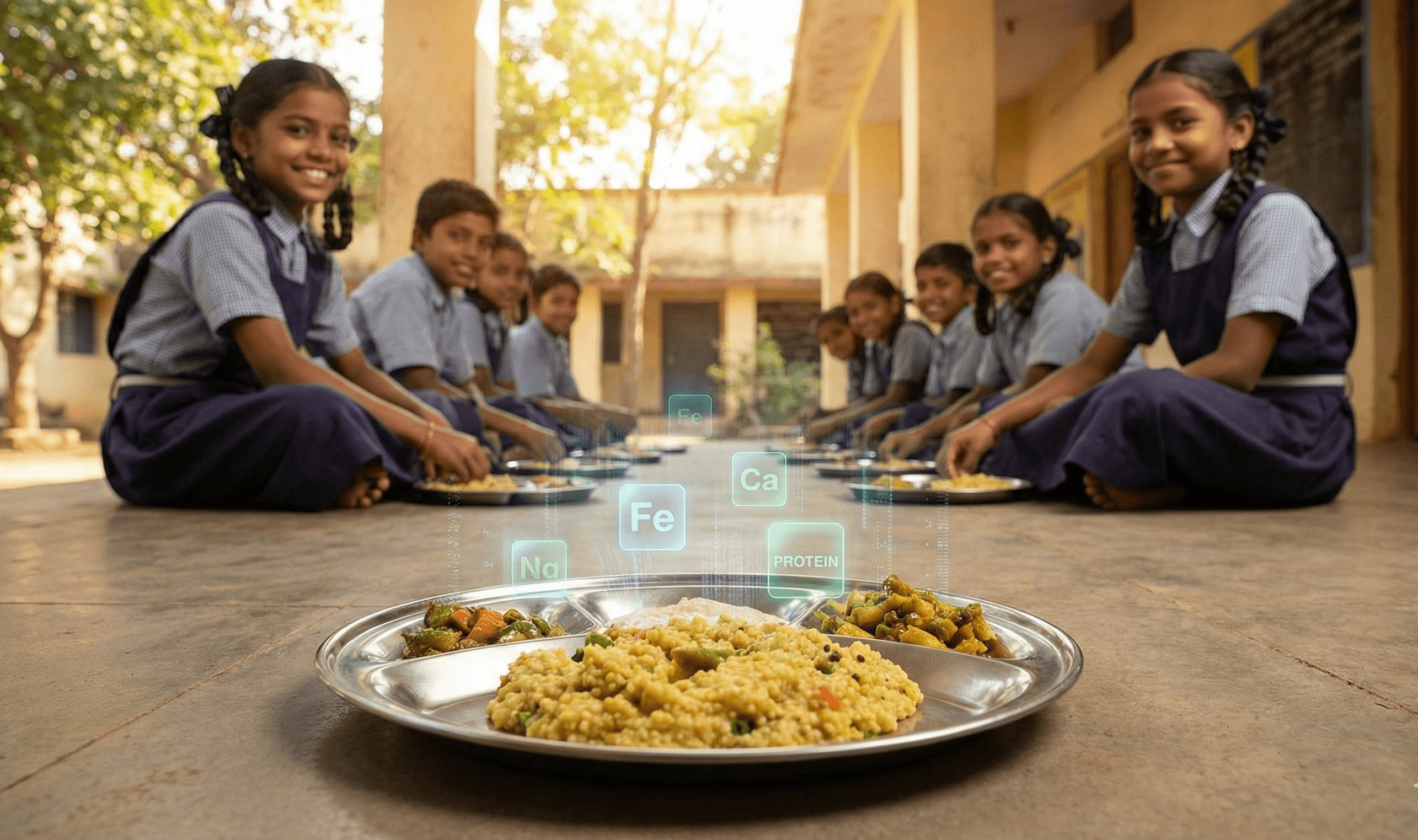
India has achieved what once seemed impossible: feeding nearly a billion people, reliably and at scale. Yet in solving hunger, its food policy may be breeding a quieter crisis - one of nutrition, not scarcity.
The Pradhan Mantri Garib Kalyan Anna Yojana (PMGKAY), which provides free rice and wheat to almost 800 million citizens, stands among the world’s largest social-protection schemes. It has protected millions from hunger and stabilised rural livelihoods. By guaranteeing two cereals, however, it has also reshaped national diets, locking households into meals that primarily fill the stomach but deprive the body of nutrient diversity.
Across much of rural India, variety has quietly vanished from the plate. The dominance of rice and wheat in the Public Distribution System (PDS) has displaced traditional crops such as millets, jowar, bajra and ragi - collectively known as nutri-cereals. Once the backbone of India’s diets, these grains were prized for their resilience, affordability and superior mineral content. In many villages of Rajasthan or Telangana, fields that once grew hardy bajra now shimmer with water-hungry paddy - subsidy regimes have changed both landscapes and diets.
What the Data Reveal
Analysis of the 2022–23 Household Consumption Expenditure Survey makes this trade-off clear. Families receiving free rice and wheat compared to those outside the scheme - is stark. Calorie intake rises by roughly 8 percent and protein by 5 percent, but these gains come almost entirely from rice and wheat, with nutri-cereals’ share in total cereals falling by nearly a tenth.
Millets and sorghum, far richer in minerals and fibre than polished rice or refined wheat, offer a nutritional edge now disappearing from the plate. Per kilogram, bajra contains nearly four times the calcium and ten times the iron found in rice. The loss is biological, not just culinary – proof that progress can feed hunger yet starve health.
The Green Revolution’s Unintended Legacy
Behind this transformation lies a long policy arc - from diversity to dependence. Before the Green Revolution of the 1970s, India’s fields and diets were regionally varied. Farmers grew crops suited to their soils and climate, and consumers ate locally. The Revolution raised yields through irrigation and improved seeds, and gradually centralised procurement and subsidies around rice and wheat. It ended famine but entrenched a policy monoculture. The Minimum Support Price system - the guaranteed floor prices offered by the government - made rice and wheat more profitable and more readily procured.
The logic of safety and subsidy narrowed both fields and diets. Traditional millets, once everyday foods, came to be seen as outdated or inferior.
Who Loses Most
The costs fall heaviest on the poor and socially marginalised. Scheduled Castes and Tribes, smallholders, landless workers and the lowest-income households show the sharpest decline in dietary diversity. For them, free rice and wheat displace the purchase of other foods; when staples cost nothing, spending scarce cash elsewhere is rational – but nutritionally costly.
Women and children bear this burden most. The National Family Health Survey of 2019 shows that more than half of Indian women aged 15–49 are anaemic – a rise even as calorie intake has improved. This contradiction exposes a flaw in how India’s Right to Food is understood in practice: it guarantees calories, but not necessarily nutrition.
States as Laboratories of Change
This pattern is not uniform. States such as Andhra Pradesh and Rajasthan – both traditional millet belts, have seen a decline in micronutrient intake within their cereal baskets, driven by the shrinking share of nutri-cereals despite the availability of free grains. In contrast, Karnataka has managed to sustain millet consumption through locally tailored interventions – such as integrating millets into the PDS and ensuring procurement at support prices.
Such variation shows a simple truth: food policy must reflect local crops, tastes and supply chains. India’s federal structure is well suited to experimentation, where successful state models can inform national design. Karnataka’s inclusion of ragi in its PDS boosted farmer incomes, stabilised regional markets and encouraged urban consumers to rediscover traditional foods. Odisha and Telangana, using minimum-support prices and local processing, have achieved similar effects. Even modest inclusion can transform markets and habits.
From Calories to Climate Resilience
The case for diversification extends beyond health. Nutri-cereals are naturally drought-resistant and low-input; they thrive where water is scarce, offering resilience in an age of climate stress. Rice and wheat, by contrast, are water-intensive crops whose expansion has depleted groundwater and exhausted soils across key grain belts. Restoring millets is therefore both a nutrition and climate-adaptation strategy.
Implementing this shift is harder. India’s grain depots and procurement systems were built for uniform crops and consumer preferences also vary sharply across states. National data still group coarse cereals together, masking regional detail. Yet these are challenges of coordination, not impossibility. India has already shown that aligned policy and political will can achieve scale. The same institutional machinery that ensured food security can now ensure nutrition security.
A Balanced Plate for the Future
A forward-looking food policy must reward diversity in procurement, monitor what households actually eat and recast millets as modern, health-enhancing foods rather than relics of poverty. Public messaging, school meals and nutrition missions can reshape perceptions as powerfully as subsidies once reshaped supply. Initiatives such as the UN’s declaration of 2023 as the International Year of Millets and NITI Aayog’s partnership with the World Food Programme on millet promotion show how national coordination can amplify local innovation.
India’s success in conquering hunger deserves credit – but the next frontier is not survival; it is well-being.