

Few ideas test India’s democracy more deeply than the quality of its public schools. For Saurabh Taneja, that test began in Anganwadi centres, where he saw how a single absence – a teacher, a meal, a working tap – could undo a child’s day. Those moments convinced him that reform isn’t about adding resources but restoring reliability and dignity.
What he saw in those anganwadis later drew him to the Akanksha Foundation – founded in 1991 by educator Shaheen Mistri, who believed that public education could be reimagined if classrooms became spaces of care, not compliance.
Three decades on, Akanksha runs 27 public-private partnership schools across Mumbai, Pune and Nagpur, educating about 14,600 students and employing 760 teachers, with more than 5,000 alumni – mostly first-generation graduates.
Now at the helm, Saurabh – an engineer-turned-educator – leads one of India’s most trusted experiments in equitable schooling. For him, Akanksha’s story isn’t about creating an alternative system but about proving that the public one can still work – given trust, autonomy and the right people.
“We were never building a parallel system,” he says. “We were proving that the public system can work – given the right people, processes and belief.”.
Learning to Lead
Saurabh’s journey into education began through the Teach For India fellowship in 2009, where he taught ten-year-olds in a crowded Mumbai classroom.
“That was the most honest feedback loop you can get,” he recalls. “Standing before fifty children teaches you humility – they show you instantly what works and what doesn’t.”
After working briefly with UNICEF and Bodhikta Samiti, he joined Akanksha – as the founding principal of its first secondary public-private partnership school in Pune, and by 2017 as its CEO. Those years in classrooms, he says, taught him that policy can propel or falter at the point where it meets real people.
Under his leadership, Akanksha has built a teacher-to-leader pipeline where teachers grow into school heads who blend care with accountability. Its training now pairs reflection with rigour, shaping leaders able to hold empathy and performance in the same hand.
When Schools Become the Social Fabric
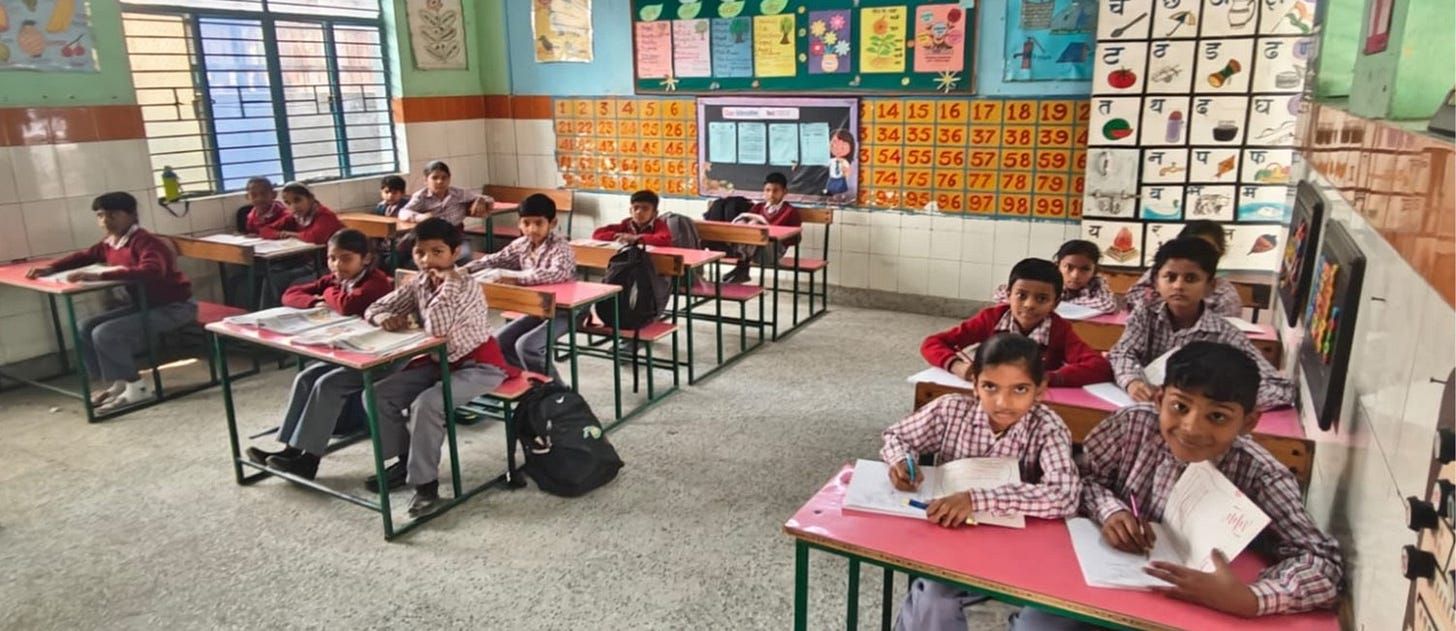
Akanksha’s schools operate in dense urban settlements such as Byculla, BD Chawl, Yerwada and Pimpri, where informal housing, high migration and insecure incomes make schooling a fragile promise. For many families, a school that consistently opens, tracks homework, and invites parental voice becomes the one dependable public institution in their lives.
The foundation institutionalises that dependability through its Parents as Partners programme. Every school forms a School Management Committee (SMC), hosts quarterly parent-volunteer sessions and arranges home-visits for first-generation learners. Together, these practices turn the school from a service provider into part of the neighbourhood’s fabric.
“The goal isn’t just to make schools predictable,” Saurabh says. “It’s to make families feel they belong inside that predictability.”
Parent-run clubs, mentorship loops with alumni, and after-school hours for art or debate turn uncertain lives into steady routines. When reliability becomes visible, attendance follows – and children start to believe their voices matter.
“Parents here already know education is the only inheritance they can offer,” Saurabh adds. “Our job is to make that inheritance feel reachable.”
Turning a School into a System
The foundation’s model rests on a straightforward equation. Government partners provide buildings, land and curriculum oversight. Akanksha and its corporate donors – including Thermax, UBS, Bajaj Finserv, Mphasis and several others – fund teachers, training, technology, field trips and learning materials. Governance is shared, but pedagogy remains autonomous.
This partnership creates flexibility inside the public system, though not without friction.
“Running a public-private school means aligning two clocks,” Saurabh notes. “The government’s calendar runs on process; the classroom runs on urgency and care.”
Classrooms prioritise discussion over dictation, and the approach – called whole-child development – integrates academic learning with social-emotional and ethical education (SEE) – helping children navigate change, build resilience and anchor themselves in the school environment. Children learn to manage conflict, practice teamwork and connect lessons to real-life issues such as finance, climate and citizenship.
The data dashboard provides the necessary monitoring layer. It tracks every academic and well-being indicator – from marks and attendance to well-being and family participation. Principals and teachers review this monthly, comparing progress and identifying support needs.
Akanksha now has ten applications for every four seats, and by 2024, over 90 percent of students completed senior secondary through junior college while 80 percent pursued higher education. Municipal schools in the same cities retain fewer than three-quarters of students, a contrast that quietly shows what trust can yield.
To scale its collaborative impact beyond its own network, Akanksha launched Project Setu, a system-strengthening initiative that works with 220 government schools, 1,000 educators and 70,000 students across Maharashtra. Through a 5 year partnership, Akanksha along with other partners, engages in capacity building of government teachers, principals, and provides a data dashboard for city leadership to influence policy shift.
“Scale without integrity defeats the purpose,” Saurabh reflects on these numbers with caution. “The question isn’t how many schools we can run, it’s how many we can run well.”
Akanksha’s work complements the National Education Policy (NEP) 2020, which promotes teacher autonomy and experiential learning. Its methods have informed Maharashtra’s School Excellence Programme – proof that public and private actors can collaborate without hierarchy.
What Policy Can Learn from Practice
Akanksha’s experience highlights three enduring lessons at the heart of India’s education policy – each drawn from practice, not theory.
First, partnerships work when roles are clear. Akanksha’s public–private compact with municipal corporations works because each side knows its lane. The government provides buildings and curricula; the foundation ensures teaching quality and outcomes. This clarity has allowed both autonomy and accountability – a rare pairing in joint ownership models.
Second, systems need partners who can model and scale, not replace. Through Project Setu, Akanksha has shown that non-profits can strengthen public systems without building parallel ones.
Third, measure all-round development, beyond enrollment and exams. Akanksha’s internal dashboards track more than test scores: attendance, well-being, and family engagement carry equal weight, while teacher autonomy and an environment for nurturing leadership remain at the core.
“If teachers and principals see themselves as system leaders, not instructors and administrators,” Saurabh says, “you get change that lasts.”
However, learning systems are evolving – across locations and over time – and so are the problems they need to solve for. Innovations that keep learning anchored in socio-economic realities, therefore, are a must. To make these innovations sustainable, governments must also guarantee predictable multi-year funding, while allowing philanthropic contributions to focus on experimentation.
“Quality costs money,” Saurabh says, “but the cost of poor education is much higher – we just don’t measure it.”
Schooling as India’s Democratic Test
For Saurabh, these lessons are not about programmes or policies – they’re about democracy itself.
“If schools work, democracy works,” he says. “It’s that simple.”
Akanksha’s goal for 2030 – to reach roughly half a million students through about 1,000 public schools in government partnerships – is ambitious, but its larger purpose is moral: to prove that trust can be built, scaled and institutionalised.
“India’s demographic dividend will mean little,” he says, “if children grow up learning to follow, not to think. Education should create agency, not echo.”
That conviction links the classroom to the Constitution: when the state, the teacher and the parent trust one another, schooling becomes the daily rehearsal of citizenship itself.