



A decade into India’s manufacturing push, one fact stands out: nearly 80 percent of components in smartphones assembled in India still come from China, and over 75 percent of our solar cells and modules are Chinese. India supplies 20 percent of the world’s generic drugs yet imports about 70 percent of key drug ingredients (APIs) from its northern neighbour. Seen through this lens, few economic relationships are as paradoxical as India and China’s.
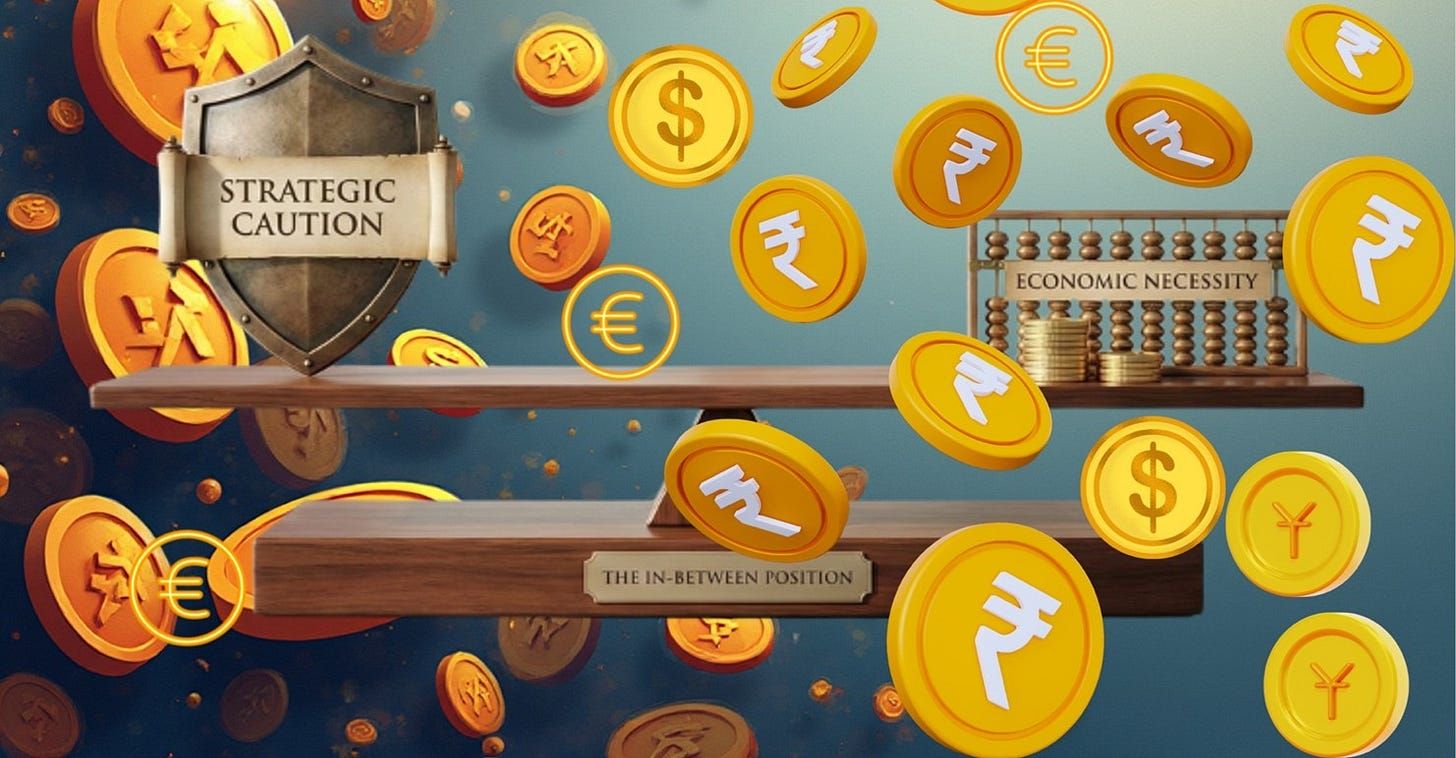
Despite India-China relationship being marked by stiff strategic competition, the two countries are deeply intertwined trade partners. While New Delhi has often sought to limit its dependence on its northern neighbour – such as by withdrawing from the Regional Comprehensive Economic Partnership (RCEP) – India’s factories, farms, and even digital infrastructure remain critically reliant on Chinese inputs. The tension between strategic caution and economic necessity lies at the heart of India’s current policy dilemma – one shared, in different forms, by much of the world. This in-between position gives India both a warning and an opportunity.
The Reality of Dependence
Between 2000 and 2019, global import dependence on China grew by over 46 percent, with manufacturing at the core. China’s share in global exports of manufactured goods climbed from 7 percent to 16.5 percent over the same period. India’s trajectory has mirrored this global trend. Even after 2020, when border tensions and security concerns drove India to ban several Chinese apps, tighten investment rules, and raise tariffs on certain imports, the overall share of Chinese goods in India’s import basket has hovered around 14–16 per cent. In some critical sectors -- electronics, pharmaceuticals (APIs), solar components, and key chemicals - dependence exceeds 30 percent.
This is not an accident of policy but of industrial structure. Over the past two decades, China became the world’s hub for intermediate goods - the components, sub-assemblies, and raw materials that power modern production. India’s export competitiveness in everything from smartphones to generic drugs is tied, often invisibly, to this supply chain. Reducing that dependence without hurting India’s export momentum will require more than protectionist reflexes.
Lessons from Others’ Decoupling Experiments
The US has spent much of the past decade trying to “wean away” from China. The Trump administration’s tariffs in 2018 and subsequent restrictions under President Biden were designed to reduce dependence on Chinese imports and curb China’s technological rise. Yet simulations of a complete US decoupling from Chinese imports reveal striking results: welfare losses - measured as real income - would be greater for the US than for China.
Why? Because American consumers and firms face higher costs when shifting to costlier suppliers; Chinese exporters redirect to other markets; and supply chains simply reroute. Products assembled in Vietnam or Mexico still carry Chinese inputs. The US pays more and China adjusts by lowering export prices to maintain its market share.
Southeast Asia offers a subtler lesson. Vietnam and Thailand gained investment through “China-plus-one” strategies, but the break is far from clean: their factories still import Chinese machinery, components, and materials. Decoupling, in practice, has become re-linking - shifting the geography of assembly while keeping China embedded in the upstream network. China’s grip on the input stage endures.
India’s Dual Challenge
For India, this balancing act is uniquely complex. On one hand, security and geopolitical considerations drive a legitimate desire to reduce exposure to Chinese suppliers, particularly in critical technologies and infrastructure. On the other hand, India’s export ambitions under Make in India and Production-Linked Incentive (PLI) schemes rely on precisely the same imported inputs that come from China.
If India were to sharply curtail these imports, its exports could decline across major sectors, especially manufacturing and agriculture. The welfare costs would likely mirror those observed in the US: consumers would face higher prices, firms higher costs, and exporters lower competitiveness. Meanwhile, China could redirect trade to other Asian and African markets, softening its own losses.
This interdependence does not imply vulnerability alone; it also offers leverage. China’s economic strength today rests on the very networks that bind it to others. India’s policy task is not to sever these links but to manage them strategically – reducing concentration risk without isolating itself from the world’s largest manufacturing base.
Diversify, Don’t Detach
What India must aim for is “de-risking” - building alternative sources of critical imports, not simply substituting one dependence for another. That involves three parallel moves:
First, develop regional supply networks. India should consider deeper integration with the ASEAN bloc and promote industrial linkages with Southeast Asia and South Asia. The goal is to attract investment and technology – particularly intermediate and capital good imports at competitive prices – that complement rather than compete with China’s strengths.
Second, invest in domestic capability for key intermediates, especially in electronics, APIs, and clean energy components. India’s industrial policy needs to move beyond final assembly towards the production of parts, materials, and machinery - the hidden layers of value where China’s dominance is deepest.
Third, embrace transparency and predictability in trade policy. Sudden import restrictions or tariff hikes may send political signals, but they also discourage long-term investment in alternative supply chains. A stable trade environment is essential for credible diversification
Turning Interdependence into Advantage
Global welfare losses from US–China decoupling extend beyond the two nations. Countries reliant on Chinese imports face price shocks and reduced demand when China’s exports fall. Conversely, a slowdown in China’s growth dampens global consumption, hurting exporters worldwide. For India, whose growth depends both on exports and on efficient access to imported inputs, any major disruption in China’s trade engine would send shocks through its own economy.
Yet there is also opportunity in this flux. China’s dominance in manufacturing is no longer unquestioned, and multinational firms are actively seeking reliable partners in Asia. India’s large market, improving logistics, and growing digital infrastructure make it a plausible alternative for select industries. The challenge is to scale up swiftly to absorb this reconfiguration and deepen industrial capacity where it matters most.
Beyond Binaries
Trade resilience comes from diversity, not dominance. Economies that rely excessively on a single partner - whether for imports or exports - are more vulnerable to shocks. India can draw on this principle to design a pragmatic form of strategic autonomy: one that preserves openness while expanding options.
Equally important is to not view China solely as a threat, but as a benchmark: an example of how industrial depth, infrastructure, and scale can reshape trade patterns.
Global trade is not a zero-sum game, where one’s gain is another’s loss. When two large economies retreat behind tariff walls, everyone loses - not just them but the rest of the world as well. The smarter course is to strengthen supply chains through cooperation, transparency, and innovation.
India’s economic growth will depend less on how fast it can move away from China, and more on how wisely it can move with - and around - it. Strategic independence will rest on diversifying risk, building depth in intermediates, and engaging the world with confidence, not retreat.