

India’s informal economy runs on women’s labour. Yet for their children, safe care remains out of reach. Construction sites, factories and farms still depend on mothers who work within sight of toddlers playing in the dust.
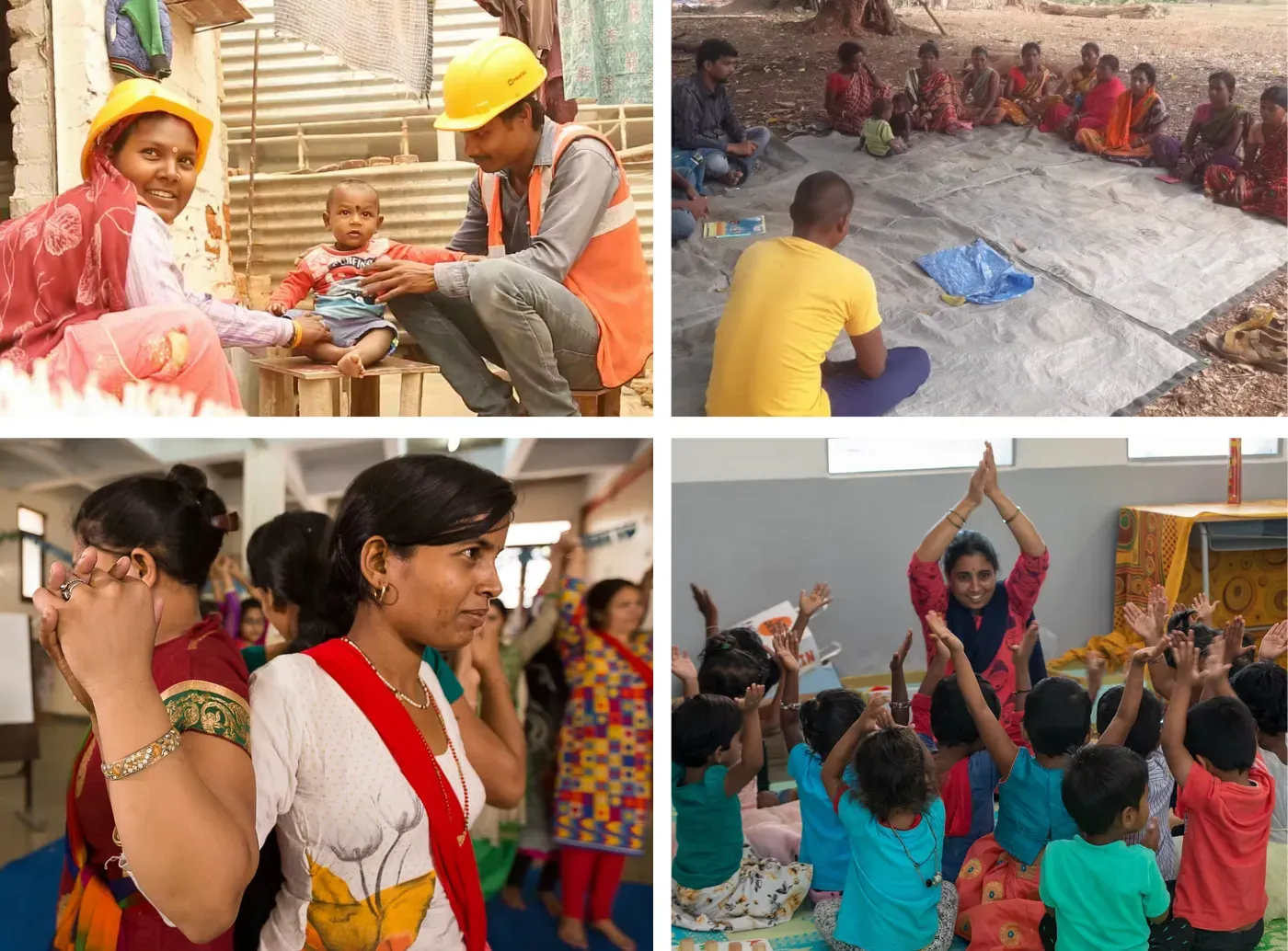
At one such site in Gurugram, a group of children sit cross-legged in a bright room, counting blocks as a caregiver guides them through early lessons in play and language. Nearby, their mothers mix cement and carry bricks. The creche is run by Mobile Creches, a Delhi-based non-profit organisation that for over five decades has built childcare systems now run by governments, employers and communities.
Founded in 1969, the organisation has since evolved into a bridge between informal workers and the state. Its mission: to make childcare part of India’s social and economic infrastructure – essential, routine, and publicly supported.
“Even at a busy construction site, we want parents to know their children are safe and learning nearby,” says Chavi Vohra, Executive Director for Strategy and Impact, “When childcare is reliable, women work better – with less stress and more purpose.”
A System Built Around Working Women
Mobile Creches’ model begins with a simple idea: a mother’s ability to work depends on her child’s care. The organisation operates what it calls a “three-step ladder” – demonstration, capacity-building, and system integration.
It starts by setting up high-quality childcare centres in partnership with employers or state agencies, showing how health, nutrition, safety and early learning can work together. Then it trains government staff and local NGOs to run those centres, develops monitoring tools, and finally steps back as public systems take ownership.
This approach has helped shape the design of India’s Integrated Child Development Services and new childcare schemes under Mission Shakti. Over time, the organisation’s teams have worked across 18 states, trained around 20,000 childcare workers, and supported more than 5,000 centres reaching roughly 55,000 children each year.
“The aim,” Chavi emphasises, “is to make ourselves redundant. When the system runs without us, we know we have succeeded.”
From Pilot to Policy
Each engagement begins with a diagnostic study – what services exist, who needs them, and where the gaps lie. The team then co-designs tools with government departments and helps establish oversight committees.
In Haryana, a partnership began after a senior official watched a short film on Mobile Creches’ work.
“He saw how it freed up women to work and helped children to learn and grow,” Chavi recalls. “That was enough to pilot a state model.”
The programme now supports hundreds of creches attached to the Women and Child Development (WCD) departments.
In Karnataka, collaboration focused on training and quality standards.
“Every state needs its own rhythm,” she says. “Our role is to help them find it.”
The process is deliberately slow. “We invest in building relationships,” Chavi adds. “Change in public systems takes time, but once it happens, it lasts.”
Caregivers at the Core
If the model works, it is because of the women who run it. Caregivers–often from the same communities as the children–are trained not only in early learning and nutrition, but also in health, safety, and the social-emotional development that shapes how young children relate to the world.
“Many begin shy and hesitant,” says Chavi. “Within months, they become educators and community leaders.”
More than 6,000 women have completed Mobile Creches’ formal training and supervision programme. The curriculum emphasises “responsive care” – engaging children through emotion, routine and play rather than rote teaching.
That shift also highlighted a larger point: childcare is a professional skill, not casual labour.
“When we treat it as a career,” Chavi says, “quality improves automatically.”
Reimagining Childcare Finance and Ownership
The pandemic years forced new thinking about finance and design. With construction work halted and creches temporarily closed, the team explored phone-based mentoring models that could survive beyond donor cycles – a programme they eventually called Furthering Parenting.
One idea that emerged was carepreneurship: training women to establish small, community-run creches supported by user fees and local monitoring. MC is currently piloting this model in Delhi in partnership with UNDP, exploring how women can run creches not just as a service but as a small enterprise that also supports other mothers in the community.
“It’s not privatisation,” Chavi insists. “It’s about building ownership. When mothers themselves run creches, they know what quality looks like.”
The model aligns with a growing national conversation about how to professionalise the care economy. According to the IWWAGE–Mobile Creches study, community-led childcare could add billions to India’s GDP by enabling more women to enter the workforce – a reminder that social infrastructure and economic growth are deeply connected.
Evidence, Policy and the Next Phase
Over 50 years, one feature has remained constant: meticulous records. Every centre tracks children’s growth, attendance, and developmental milestones; every training is logged. That record-keeping has been central to influencing policy.
“Evidence persuades faster than emotion,” Chavi says. “When we can clearly show improvements in children’s development and wellbeing, policymakers listen.
To systematise this, the organisation developed Measurement for Change, a framework linking monitoring and evaluation to strategy. The data now inform cost models, policy briefs, and state guidelines for childcare quality.
This evidence-first approach has given Mobile Creches an unusual role: part implementer, part policy partner. Its reports have fed into national consultations on the future of early childhood care, and its training modules are being used by several state departments.
A Reform in Plain Sight
India’s conversation about childcare is shifting. Once viewed as a welfare add-on, it is now part of the debate on women’s workforce participation, which remains below major economies.
Government schemes under Mission Shakti and the New Education Policy are expanding early childhood coverage, but much depends on how effectively they converge across departments. The models pioneered by Mobile Crechesshow what that convergence looks like on the ground: health, nutrition, safety, and early learning delivered in one place, for one purpose.
At the Gurugram site, the mothers return at dusk, collecting their children before heading home. The creche will reopen the next morning, six days a week, as it has for years, offering families the stability that makes both work and early learning possible – the kind of everyday infrastructure that contributes to India becoming a Viksit Bharat.
For Chavi, this moment captures a broader truth.
“When a mother can work without worry, and a child can learn without risk,” she says, “you’ve built real infrastructure – not in concrete, but in care.”