



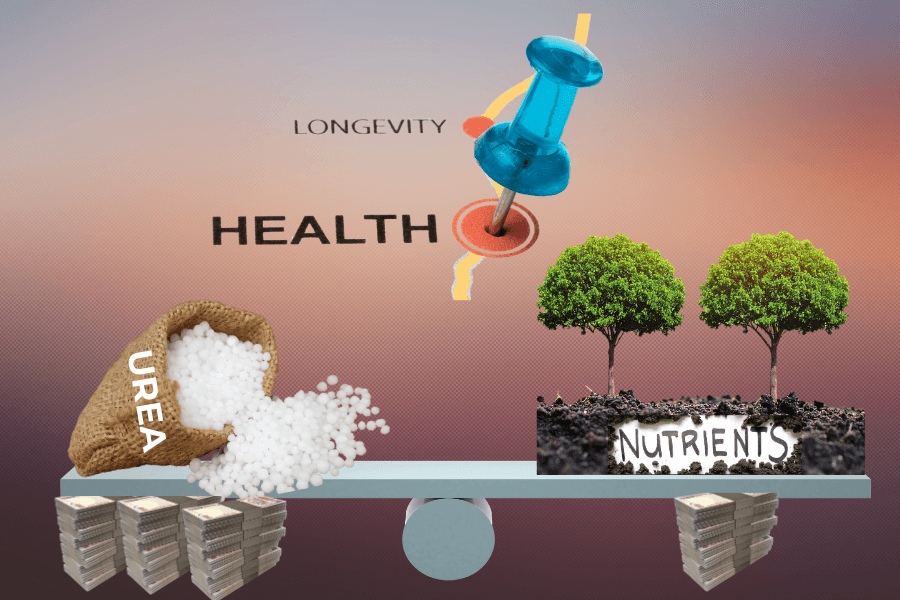
India’s fertilizer subsidy regime has reached a point where its original success has become its greatest constraint. Designed to ensure food security and protect farmers from price volatility, the system has succeeded in expanding fertilizer availability and boosting yields. But decades later, the same framework is now locking Indian agriculture into distorted nutrient use, rising fiscal costs, and growing environmental risk. The question is no longer whether fertilizer subsidies should continue, but whether they can be redesigned to reward outcomes rather than consumption.
India today consumes around 30 million tonnes of fertilizers annually. Nitrogen alone accounts for nearly two-thirds of this use, while phosphorus and potash lag behind. This imbalance is not accidental – it is the direct result of policy choices that made urea uniquely affordable and widely available, while allowing prices of other nutrients to rise. The consequences are increasingly visible in declining soil health, stagnating productivity gains, and mounting environmental externalities.
The Cost of Urea Exceptionalism
At the heart of India’s fertilizer challenge lies urea’s exceptional treatment. While phosphorus and potash are governed under the Nutrient-Based Subsidy (NBS) regime, urea remains price-controlled, with manufacturers compensated for the gap between production costs and fixed retail prices. This has ensured availability, but at a high fiscal cost: fiscal outlays have expanded sharply, rising from roughly ₹12,000 crore in the early 2000s to over ₹1.5 lakh crore in recent years.
More importantly, urea’s artificially low price has skewed farmer behaviour. When nitrogen is cheap and abundant, balanced nutrient management becomes economically irrational. Over time, this leads to soil degradation, lower nutrient-use efficiency, and diminishing returns to fertilizer application. Evidence from household surveys underscores how little space current incentives leave for sustainable alternatives: for every rupee farmers spend on bio-inputs, over six rupees go toward chemical fertilizers.
Yet, reforming urea pricing has remained politically sensitive. Food security concerns, fears of farmer backlash, and inter-state distribution politics have made policymakers cautious. This caution, however, has come at the cost of long-term sustainability.
Why Abolition is not the Answer
Calls to abolish fertilizer subsidies altogether resurface whenever fiscal pressures intensify. Such proposals underestimate the role fertilizers continue to play in stabilizing food production and farm incomes. An abrupt withdrawal would risk sharp yield declines, price instability, and rural distress – outcomes that would undermine both food security and political stability.
The real challenge, therefore, is not whether subsidies should exist, but how they should function. A uniform, input-based subsidy regime that ignores crop type, soil condition, or environmental impact is no longer defensible. What India needs is a gradual but decisive shift from price suppression to incentive alignment.
From Input Subsidies to Outcome Incentives
Three reform priorities deserve urgent attention.
First, nutrient neutrality must replace product favouritism. As long as urea remains artificially cheaper than other nutrients, imbalance will persist. This does not require sudden price shocks. A phased convergence, paired with transparent compensation mechanisms, can reduce distortions while protecting small and marginal farmers.
Second, subsidies must begin to reward outcomes rather than volumes. Current transfers incentivise higher consumption, not better practices. Linking support to indicators such as balanced nutrient use, soil health improvement, or reduced emissions would realign farmer incentives without withdrawing state support.
Third, bio-inputs and sustainable fertilizers must move from the margins to the mainstream. Despite repeated policy endorsements, their adoption remains limited because they lack both price parity and institutional backing. Without targeted incentives, extension support, and reliable supply chains, awareness campaigns alone will not change behaviour.
Recent initiatives such as One Nation One Fertilizer and Pradhan Mantri Krishi Samrudhi Kendras point to a recognition that fertilizer policy must move beyond price controls toward integrated service delivery. However, these efforts will fall short unless they are embedded within a broader incentive redesign.
Managing the Political Economy of Reform
Fertilizer reform is as much a political challenge as an economic one. States differ widely in cropping patterns, soil conditions, and fertilizer dependence. Any redesign must therefore allow flexibility while maintaining national coherence. Direct Benefit Transfer mechanisms offer transparency and reduce leakages, but they do not automatically change usage behaviour unless paired with differentiated incentives.
Emerging instruments, such as carbon markets and green credit systems, offer a complementary pathway. If farmers can be rewarded for reducing emissions or improving soil carbon, fertilizer subsidies could gradually evolve into climate-smart support mechanisms rather than blunt fiscal tools.
The Real Stakes
India’s fertilizer subsidies now sit at the intersection of food security, fiscal sustainability, and environmental resilience. Continuing with the status quo risks locking the country into rising subsidy bills, deteriorating soils, and diminishing productivity gains. Moving too abruptly, however, risks destabilizing farm livelihoods.
The policy choice, therefore, is not between support and reform, but between passive continuation and purposeful transition. A future-ready subsidy framework must recognize that sustainability is no longer a peripheral concern – it is central to agricultural viability itself.