

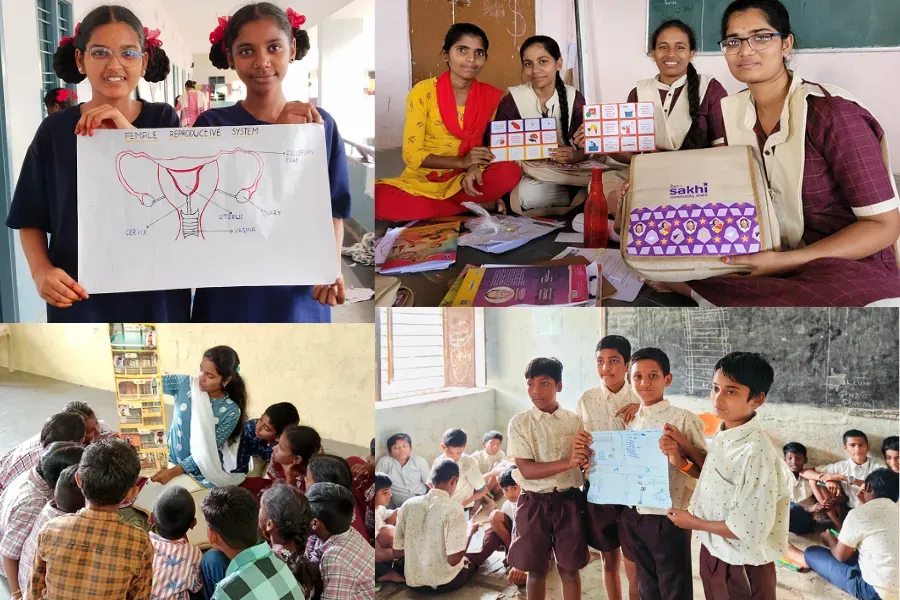
In thousands of India’s government schools, adolescence arrives quietly but heavily. Girls enter a stage of life filled with rules, silence, and expectations, yet receive little support in understanding their bodies or their rights. VOICE-4 (V4) was created in 2012 to change this reality by building safe, structured spaces inside government schools where girls can ask questions, express fears, and begin to trust their own voice.
Its Founder and Strategic Advisor, Anusha Bharadwaj, entered the development sector two decades ago “just to explore,” but found her calling the moment she began listening closely to adolescent girls.
“They are often surrounded by silence,” she says. “Breaking that silence – with facts, with skills, with honest conversations – is what begins to unlock their agency.”
Her early fieldwork revealed not theoretical gaps but urgent, lived ones – gaps that would eventually shape the V4 model.
What the Field Taught, and Why It Led to V4
Two encounters stayed with Anusha because they revealed what adolescence looks like when support is absent. The first was Chandu, a girl who had survived severe trauma yet carried a steadiness that defied expectation.
“Chandu showed me that resilience is often quiet,” Anusha recalls. “It’s the instinct to survive even when the world gives you very little. With even a small ray of hope and possibility, girls begin shaping their own pathways.”
The second was a 13-year-old child bride, whom she met during a routine school-health visit.
“She should have been in her seventh-grade classroom,” Anusha says. “Instead, she was negotiating a marriage. That day, something shifted. I was angry that she had no say in her own future – but even angrier that no one else seemed troubled by it. Officials, community members, family elders all saw it as normal. Shouldn’t we have been outraged? This can’t be the future we accept for our children.”
These experiences clarified a simple truth: adolescence is where vulnerability deepens, but it is also where the possibility of agency begins. V4 was built to intervene at precisely this moment – not with sporadic sessions, but with consistent, emotionally safe environments where girls could learn to understand themselves.
The V4 Approach: Safe Spaces with Structure
V4 builds what it calls Gender-Transformative Safe Spaces – structured, inclusive environments inside schools where adolescents can reflect openly on identity, equality, and safety. Unlike generic awareness programmes, these spaces are designed to shift mindsets: they help girls question restrictive norms, revisit beliefs absorbed in childhood, and experience what agency feels like in practice.
V4’s flagship programme, Her VOICE, is a sequenced 30-day curriculum delivered across the school year in three 10-day camps, each designed to build from self-understanding to self-advocacy. In these camps, college-going women counsellors spend full days with girls, using storytelling, reflection circles, role-play, games, and guided discussion to explore puberty, menstruation, safety, communication, emotions, and aspirations. The pedagogy is deliberately activity-based because, as Anusha notes,
“Girls don’t open up because you give them a fact. They open up when they see agency.”
Girls are invited to contextualise information in their own lives and to co-create solutions. For example, when the process of menstruation is explained and girls learn that menstrual blood is not “dirty”, each girl relates this to her own beliefs and practices, and her actions are then tailored to that context.
The model fills a gap schools struggle to address. Teachers may want to support adolescents but often lack the training – or the comfort – to discuss menstruation, consent, or gender norms. Many also carry the same social biases as the communities they serve. By bringing structured, stigma-free conversations into schools, V4 makes these topics normal rather than taboo.
The impact is visible. After camps, girls’ understanding of menstruation as “normal” rises from 17 percent to over 75 percent, and clarity on how to seek help in unsafe situations increases by 70 percent. Boys also show an 85 percent improvement in understanding puberty for both genders.
“These aren’t small shifts,” Anusha says. “They are shifts that change how adolescents move through their world.”
Girls-4-Girl: The Counsellor Engine
One of the most distinctive elements of V4 is its Girls-4-Girl approach. Camps are facilitated entirely by university students who undergo intensive training in facilitation, child protection, gender pedagogy, and adolescent engagement. Their age creates instant relatability.
“When a 19-year-old stands in front of a 13-year-old,” Anusha explains, “the message is: ‘She is like me. If she can speak up, maybe I can too.’”
The model also transforms the counsellors. Many describe their time in rural or marginalised communities as eye-opening – an experience that shapes their understanding of opportunity, inequality, and responsibility. Some go on to pursue teaching, social work, community leadership, or public policy. V4 extends this leadership ecosystem through Sakhi Peer Leadership, training adolescent girls to guide peers within their own schools.
V4 has deepened this mission by training 7,000 female college students to serve as leader-mentors. These mentors are paired with high-risk rural and tribal girls, forming a mentoring network that now spans seven states. Since 2012, V4 has worked with around 165,000 adolescents who have in-turn reached out to around 135,000 adolescents.
Working with Government Schools, Not Around Them
V4 anchors its work inside government systems. Camps are coordinated with headmasters, teachers, hostel wardens, and district authorities to ensure alignment with school calendars and safety norms. This grounding ensures that the programme complements school life instead of interrupting it.
The organisation also works with boys, parents, and school staff because gender norms are collectively reinforced.
“Patriarchy is not male or female,” Anusha says. “It’s systemic. So, change has to move through the systems around girls too.”
By keeping its methods low-resource and activity-based, V4 ensures that gender-transformative practices can be adapted by schools even beyond the camps.
From Practice to Insight: Stories That Shape Systems
As V4 grows, it is investing more deliberately in storytelling, documentation, and evidence-building – not for publicity, but for influence. Its work across thousands of girls, counsellors, and school environments is creating a body of insights on what safe spaces do, how girls express agency when given continuity, and how gender norms begin to loosen in school settings.
“If our stories and evidence can shape better policy,” Anusha smiles, “that’s the impact that outlives any single camp.”
This orientation reflects the organisation’s belief that systemic change requires institutional adoption, not isolated projects.
The Quiet Transformations That Matter
Across classrooms and hostels, V4 has worked with over 300,000 adolescents (girls and boys) in government schools, witnessing small but defining shifts: girls recognising unsafe behaviour for the first time, boys questioning stereotypes they once absorbed, peer leaders guiding younger classmates, and counsellors returning home with a sharper sense of justice.
The transformation fueled by V4 is evident: 98 percent of the girls who have participated, have pursued higher education, gained employment, or started businesses. This success has led government officials to invite V4 to expand the model to 100 new districts, aiming to broaden state outreach and strengthen civil society partnerships throughout India.
“Every time a girl says, ‘I didn’t know I had the right to say this,’” Anusha reflects, “that is a moment of transformation. It may not be loud. But it lasts.”
Across thousands of adolescents in hundreds of schools, these small moments accumulate into something larger: a steady rewriting of what girlhood in India is allowed to be.