


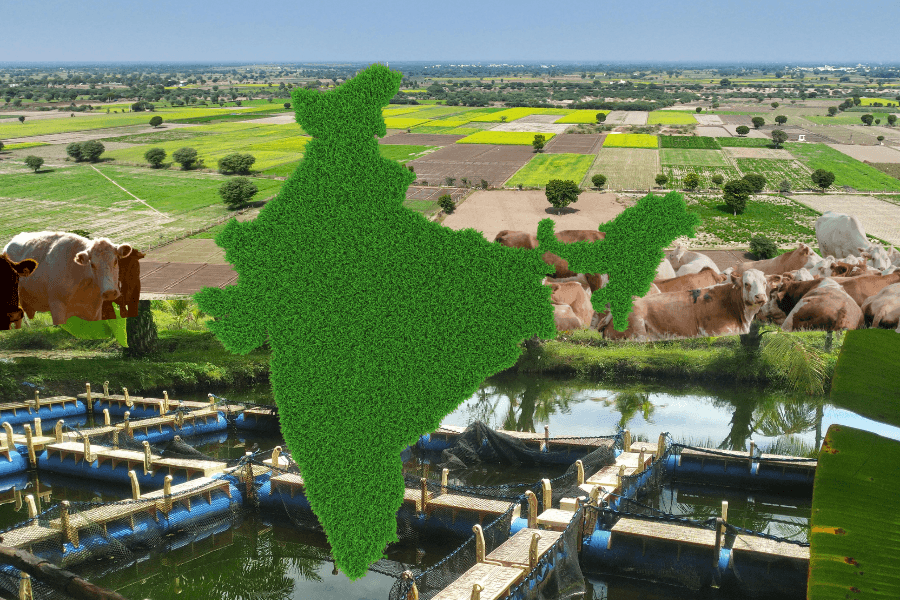
State-level economic growth in India continues to be closely associated with agricultural performance, despite agriculture’s declining share in overall output. Over the past decade and a half, states that have recorded faster growth in agriculture and allied activities have also tended to grow faster overall. What distinguishes today’s landscape, however, is not whether agriculture matters, but where growth is coming from – and how differently it now contributes to growth across states. These differences reflect fundamentally divergent trajectories. India’s agricultural growth challenge is no longer primarily about raising yields within existing systems, but about escaping structural lock-in.
Uneven Growth is No Longer a Puzzle – It’s a Pattern
This divergence is visible in the widening gap between states. State-level data on agriculture and allied activities from 2011–12 to 2024–25, covering all major states, suggests that while agriculture and allied activities have grown at roughly 4 percent annually at the national level, a group of states has consistently outperformed this average. Andhra Pradesh has recorded growth close to 8 percent, with Madhya Pradesh around 6.5 percent and Telangana and Assam above 5.5 percent. At the other end, major cereal-producing states such as Punjab and Haryana have seen agricultural growth slow to just over 2 percent. These gaps are no longer cyclical fluctuations. They signal the growing cost of remaining anchored to production systems that are increasingly misaligned with demand, value addition, and ecological constraints.
The Fastest-Growing States are Growing Differently
The contrast becomes sharper when growth is decomposed by sector. In the fastest-growing states, agricultural expansion is no longer driven primarily by crops. Instead, livestock, fisheries, and other allied activities account for a substantial – and often dominant – share of growth. In Andhra Pradesh, rapid expansion in fisheries and aquaculture has coincided with strong overall agricultural performance. In states such as Tamil Nadu, Rajasthan, Haryana, and Bihar, livestock contributes more to agricultural growth than crops themselves. At the national level, livestock alone now contributes roughly as much to agricultural growth as the crop sector, underscoring how far the centre of gravity has shifted.
In several high-performing states, livestock and fisheries together account for well over half of total agricultural growth. These sectors benefit directly from urbanisation, income growth, and changing diets, while also offering higher value addition than cereal cultivation. Unlike cereals, they generate growth by responding to demand rather than relying on price support and procurement guarantees. As these structural forces intensify, the gap between states that have diversified and those that remain cereal-anchored is likely to widen further.
The Exception that Confirms the Pattern
Madhya Pradesh stands out as an exception. Its relatively high agricultural growth has been driven largely by crops, but this outcome reflects a specific policy and infrastructure context rather than a broader cereal revival. Expanded irrigation, improved power availability, and supportive procurement conditions have underpinned growth. Crop-led growth here is the result of sustained policy scaffolding, not a replicable return to cereal-led expansion elsewhere.
Why Cereal-Centric Systems Now Act as a Brake
Nowhere is the cost of cereal anchoring clearer than in states with highly cereal-dominated production systems. Punjab and Haryana, once central to India’s food security strategy, now exhibit some of the lowest growth rates in agriculture and allied activities. The issue is not productivity alone. It is structural. A high concentration of cropped area under cereals limits diversification, discourages investment in allied sectors, and locks farmers into production patterns that deliver diminishing returns.
These systems are further burdened by mounting environmental costs. Groundwater depletion, rising input intensity, and stagnant yields have increased production costs while eroding long-term sustainability. What once functioned as a stabilising policy framework is increasingly acting as a brake on growth. Cereal-centric incentives that were designed to ensure food security are now constraining the very transformation required to sustain agricultural incomes.
Allied Sectors are No Longer Supplementary
Despite this shift, agricultural policy continues to treat livestock, fisheries, and other allied activities as peripheral to the core task of crop production. This view no longer holds. Allied sectors are now central to income growth, risk reduction, and structural transformation, particularly for smallholders. Livestock complements crop production through the use of residues as feed and the return of nutrients to soil, but its more important role lies in providing relatively stable income flows that reduce vulnerability to weather shocks and price volatility.
Fisheries and aquaculture, though geographically concentrated, generate high value-added with limited land requirements and strong links to domestic and export markets. Forestry plays a similar role in hill and northeastern states, where ecological constraints limit crop expansion but forest-based activities offer viable growth pathways. States that have aligned agricultural strategy with local ecological and market conditions have performed better than those that have persisted with uniform, crop-centric models.
Policy is Still Anchored to Cereals – Growth is Not
The policy implication is no longer ambiguous. India’s agricultural framework remains anchored to cereals even as the sources of growth have shifted elsewhere. Diversification must therefore move from rhetorical commitment to strategic priority. Livestock, fisheries, and horticulture require targeted investments in veterinary services, disease control, cold chains, credit, and market access – investments that generic, crop-focused schemes are ill-equipped to deliver.
Procurement and price policies also require recalibration. Food security remains essential, but cereal-centric incentives can no longer dominate agricultural strategy in states where they constrain diversification and degrade natural resources. Treating cereals as the default anchor of support is now a policy liability rather than a safety net. Finally, agricultural policy must become explicitly state-specific. Coastal aquaculture economies, groundwater-stressed plains, and hill states face fundamentally different constraints and opportunities. Growth has followed alignment with local conditions, not uniform design imposed from the centre.
From Legacy Success to Future Growth
India’s next phase of agricultural growth will not come from producing more of the same crops more efficiently. It will come from building capabilities in allied sectors that reflect changing demand patterns, ecological limits, and income aspirations. States that have recognised this shift are already pulling ahead. Those that have not risk converting past success into present drag. Agriculture still matters, but the policy core around which it is organised must now change.
The choice now is between redesigning agricultural policy for diversification – or managing the slow erosion of growth in states that once led it.